Posts Tagged ‘ Plymouth Historical Society ’

Of Concrete City, Mermaids and Ghosts (both Past & Present) Part 2
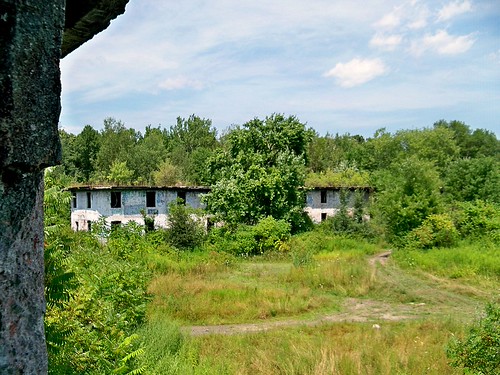
CCCCHeader 2011

Concrete City 2011

Don’t ever believe the hype about anything.   Almost seventy-six  years ago, on September 13, 1938, Luzerne County’s well-respected news authority, The Sunday Independent, reported about a Ghost Town, called Concrete City, which had been, “left to the ravages of time and scurrying rats”, after a 15 year span  in limbo as an abandonment.

CCCGhosts 1 2013

Concrete City Still Standing in the New Millennium

What was the implied fear in 1938?  Concrete City had become a contradiction!  You see, historians seemed to be claiming that the city had become “only a memory”, yet, there it was, all up in your face. Concrete City had morphed into an apparition for all to witness!

These abandoned homes, once considered a model of modern efficiency, have even survived the dawn of a new millennium, remaining nestled in their wooded area on the boundary between Hanover Township and the city of Nanticoke, Pennsylvania, with their industrial-strength existence still generating a lot of interest, which is nothing new.  When these homes were first built, the local headlines exclaimed “Good-Bye To That Landscape Eyesore—The Mine Patch! Workmen’s Homes At Concrete City Are Virtual Villas” in the September 26, 1914 issue of the Times Leader.

Historical View of Concrete City

Historical View of Concrete City

And just in case anyone thinks that hanging out in the abandoned city is some new phenomenon, I’d like to share a blurb I found in the The Sunday Independent from November 18, 1945:

“A Nanticoke resident who had put his heating stove on the back porch last spring found it missing when he went out there to bring it into the house for the coming cold weather.  The cover was still up; however, giving the impression the stove had been there all the time.  He remembered that some youngsters have a “bunk” in one of the abandoned Concrete City houses and upon investigation found his heater there. “

CCCGhosts7

I’ve blogged about NEPA’s infamous Ghost Town, and constantly evolving street art gallery, several times. In fact, Concrete City was my first Guerrilla History post (and how I cringe when I look back at those pictures)!    I still love finding new information to share, not that it is necessarily “new” information– just new to faux historians, like me!  As mentioned in Part 1 of this blog entry, I recently visited the Luzerne County Historical Society to read a Wilkes College Archaeological Field Methods study from 1982.

Concrete City was opened in 1914 and was lived in by 40 families until it was abandoned in 1923.  Everyone living there had a male family member working at the Truesdale Colliery, just a ¼ mile walk away.  It was considered to be ahead of its time, despite the lack of indoor plumbing or heat and electricity.  So what was life really like in this community with homes described as “virtual villas”?

CCCGhosts6

According to that archaeological report, the city was built in the form of a rectangle with all of the houses facing inwards.  Four double block homes are located in the front, which mirrors the units at the back of the property, with eight units on each side.

There used to be a road of crushed shale rock circling the inside of the complex and a single tree was planted in front of each unit, creating a uniform line.  A lawn area was planted in front of the houses and each family was required to have a lawn mower.  Large community trash bins were located near the front of the complex.

Concrete City Historical View

Concrete City Historical View

The homes had dark green trimming and red chimneys.  Concrete walks led to the front and side doors.  Each building had French windows with flower boxes attached.  Hung above every front door by chains was a marquis roof.   A wooden coal shanty and outhouse were built at the rear of each unit, leaving ample space for flower or vegetable gardens.

CCCGhosts2

There was a central well located in the middle of the complex since there was no indoor plumbing.  Water was heated on kitchen stoves so the family members could bathe in a concrete tub located in the kitchen, which was also used to wash clothing.  The garments were then either hung outside when it was warm and dry, or put up “on lines in the enclosed, upstairs back porch during cold weather”.
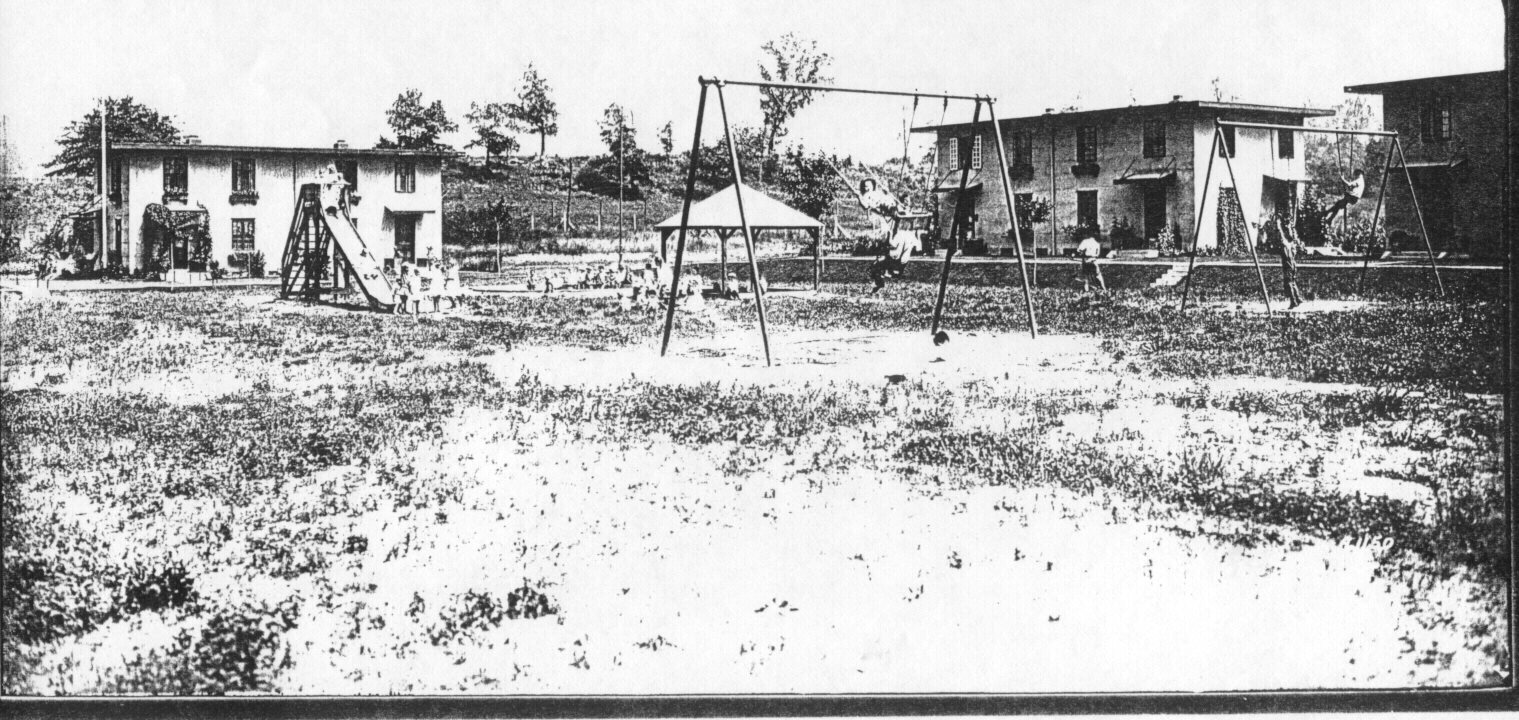
ccc876

Also in the center of the complex was a baseball diamond, a tennis court and a playground with teeter totters, swings and gymnastic rings.  There was a concrete wading pool for kids and a waist deep, concrete swimming pool for adults.  These were the first in-ground pools built in Wyoming Valley.  The Times Leader described the scene in 1914:

“A circular swimming pool with constantly flowing water was installed in one corner of the big central square and on hot afternoons many of the children, some in improvised swimming costumes  and some with the alarming lack of them that characterizes the swimmin’ hole boy, disported themselves in its safety shallow waters. For there are between eighty and ninety children in Concrete City, and evidences of their presence abound.  Behind this house there is a child’s double seated swing.  In front of that, a benignant collie prowls and smiles upon the tumbling infants.  Even all the rag dolls are not taken in every night.”

ccc pool

Sadly, some accounts say that the adult pool was filled in after a young boy drowned in it.

The city was occupied for nine years before closing.   The archaeological report says, “It was closed, because cracks had developed in a few of the buildings and there were many water and sewage draining problems that could not be resolved.  The Glen Alden Coal Company considered the installation of a sewage system much too costly and decided to shut down the village in 1923.”

The report also says that no evidence is left of the outhouses, coal shanties, playgrounds, a tennis court or baseball diamond.  But apparently in 1982 you could still see the pool.  I can’t say that I’ve personally seen any evidence of it these days and I think I know what may have eventually led to its demise.  According to an article in the Citizens’ Voice on April 19, 1979, “Beautiful Village Now Fire Training School”, the pool was cleaned out and filled with oil and various types of debris to teach firemen how to extinguish oil fires.  What an ironic after-life experience for the drowning victim, that is, if you follow (& believe in) shows about hunting for ghosts in abandoned places. Someone should call Zak Bagans about this!

I’m often contacted by amateur ghost hunters asking if I have knowledge of anyone passing away at abandoned places.  Thanks to the research efforts of genealogist, Plymouth Historical Society Board Member, historical preservationist and living historian, Amy Cargill Kirkpatrick, I have an actual obituary connected to Concrete City.

2-20-1922

Henry Slusser—Heart trouble caused the death Saturday afternoon of Henry Slusser at his home in Concrete City.  He was a former resident of Black Creek Township and is survived by his wife and two step children.  Harold Copeland, at home and Mrs. Walter Sherman of Wanamie; also two brothers, Roger and Rueben Slusser.  The funeral will be hold from the family home Wednesday afternoon at 2 o’clock.  Services will be held at the residence and interment and interment and Edge Hill Cemetery.

In terms of the little boy who drowned, the only newspaper information I was able to locate so far was a quote from a former resident in the Citizens’ Voice article mentioned above.  Another tidbit of information I gleaned from that article was that the homes were originally built for mining officials, but “as more imposing homes were built later for the officials, the concrete structures were rented to the better class of miners.”

CCCGhosts3

According to The Sunday Independent, July 23, 1939, “When the word went out to abandon the settlement, doors, windows and shelves were removed.  The concrete structures themselves have withstood the wear of the elements and still stand erect for the most part.  Only one has crumbled. “

CCCGhosts4

CCCGhosts5

Not a whole lot of rapid change has occurred at Concrete City within the last 76 years.  You have to wonder if the space will ever get the opportunity to develop into something else.  While taking photos of mermaid inspired leggings for the creator of Skinny Jeans and Sippy Cups, Adrienne  Shellenberger (featured in Part 1), I said that I wished I could make a better connection between Concrete City and mermaids for my blog post.  Adrienne said, “That’s ok.  I like things that are random.  Besides, everything evolves from the sea.”  Maybe the fact that mermaids and artists have made their way to Concrete City is a sign that evolution is finally underway.

5 ccc
Snow Mermaid at Concrete City–Don’t Miss Part 1

*~*

Return to

Guerrilla History

TABLE OF CONTENTS

Cheri Sundra © 2014
All Rights Reserved

I’ve Got The Power…..

Power D

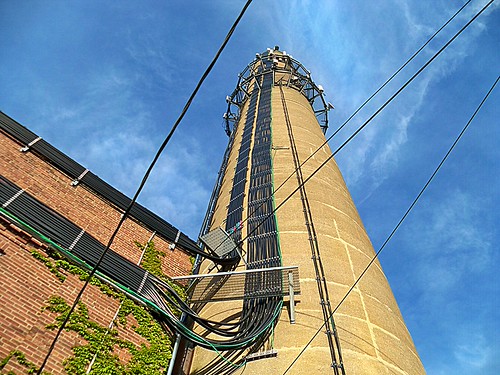
Generations of families living near the Susquehanna River in Plymouth, or passing over the Carey Avenue Bridge, have grown accustom to seeing the huge smokestacks looming in the background. 

Power in the 50s

1950s (?) era picture with smokestacks in background

While the smokestacks have been dormant for many decades, and in some ways, have even changed with the times because, apparently, they now have something to do with providing cellular service, they still stand as a monument to a more powerful time—a time when humans first became God-like in their ability to provide artificial light, on a grand scale, during the darkest hours of the night.

"I've Got The Power......."
"I've Got The Power........"

In 1882, the first commercial power station opened in New York City.   Just two years later, The Wilkes-Barre Electric Company, along with Hildreth & Co. (Nanticoke), started offering service in some areas of Luzerne County.   

"I've Got The Power........”

Locally, it was primarily our West Side Communities that were the pioneers in electrical power and lighting for the area.  Nanticoke, Kingston, Wyoming, Forty Fort, Luzerne, Plymouth and Shickshinny all constructed power plants to meet the growing needs of this exciting, new industry. 

"I've Got The Power........It's gettin' it's gettin' it's gettin' kinda hectic”

“I’ve Got The Power……..It’s gettin’ it’s gettin’ it’s gettin’ kinda hectic……”

"I've Got The Power........It's gettin' it's gettin' it's gettin' kinda hectic”

Eventually, they all merged and consolidated into one big “light plant” that took over the responsibility for serving the entire area, which is what you still see standing today  at the river’s edge, on the corner of Bridge and Beade Streets.  Built in 1905, it was the fifth power plant erected in Plymouth.   

b Power

The very first power plant to operate in Plymouth opened in 1886 on Cherry Street.  During the early years of the lighting industry, commercial lighting was only furnished during “lighting hours” and only street lights were on the “moonlight”, or “all night”, schedule. I find it compelling to contemplate the notion that at one point humans had little control over darkness, and then we found a way to master the darkness by distributing artificial light. 

Abandoned Pennsylvania:  "I've Got The Power...."

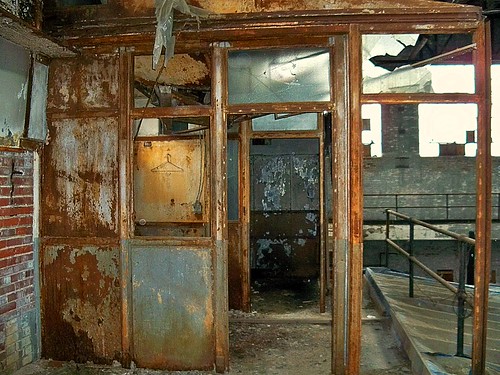
"I've Got The Power........It's gettin' it's gettin' it's gettin' kinda hectic”  {EXPLORE}Can you spot the wire hanger still in place on the wall?

Today, the Plymouth Light Plant still stands, in a state of semi-abandonment.  The front portion of the building, bordering Bridge Street, is used as a rental storage facility, while the back portion of the structure remains unused.  The grounds around the back, with all of the “High Voltage” electrical service structures, make up the UGI Electrical Service Plymouth Substation. 

Power I
Power A

A big “thanks” to the Plymouth Historical Society for providing me with the information about the Plymouth Power Plant!  I was unable find anything on my own…..

Power Ghost Sign

Luzerne County Gas & Electric Corporation “ghost sign” overlooking the Susquehanna River

Power H
a Power

Power 9

Power 7

Power 6
Power 5

Power 4
Power 3
Power 2
Power J
Power F
Power B
Power C
Power E
I've Got The Power
Power G

Power 12

Smokestack as it looks from the front of the home

that belonged to my grandparents on Beade Street

@@@@@@@@@@@@

Return To

GUERRILLA HISTORY Table of Contents


Cheri Sundra © 2012
All Rights Reserved

***NEW UPDATES for: “Lost History Found : Croop’s Glen Amusement Park, Hunlock Creek, Pennsylvania”

Since my last post about “Lost History” at Croop’s Glen, an abandoned amusement park located on Route 11 right outside of Nanticoke Pennsylvania, two more people have contacted me to share information about this long abandoned amusement park!

Photo memorabilia donated by Frank Regulski, courtesy of Sheila M. Brandon

Sheila M. Brandon of Sweet Valley, Pennsylvania, used to maintain a history website that contained information about Croop’s Glen and pictures of the Hunlock Creek Train Station.  She very graciously sent me pictures and information from her now defunct web site, which covered topics from Lower Luzerne County, to use for this blog.

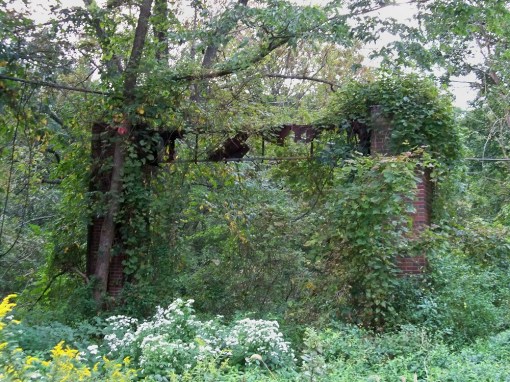
From Sheila’s information, I’ve learned that the structure that you first encounter when you look over the guard rail and into the park, used to be a ticket booth.  It’s interesting to view the changes that have occurred over a relatively short period of time to this structure, thanks to the ravages of time and Mother Nature.

“Ticket Booth” courtesy of Sheila M. Brandon

Again After Recent Flood on September 17, 2011–My own photo

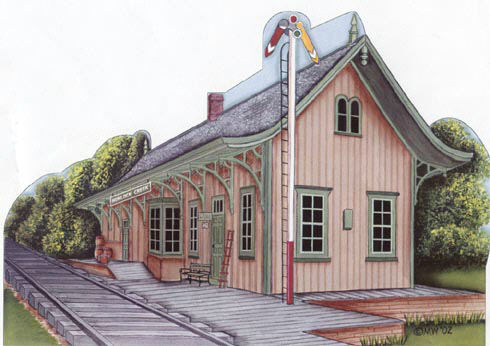
Part of Croop’s Glen’s success was the fact that it was located across the street from the Hunlock Creek Train Station.   From the copy used for Sheila’s webpage:

 “The rolling thunder of the approaching train was heard as it neared the station at Hunlock Creek, bringing visitors from all over, coming to enjoy a warm summer day at the glen…the sounds of children’s laughter could be heard echoing through the trees.. the warm babbling brook sang ever so sweetly, inviting the visitor to come take a swim.. the smell of popcorn and cotton candy filled the air.. beautiful melodies played under the dance pavilion as the adults danced the night away.”

“Hunlock Creek Train Station” courtesy of Sheila M. Brandon

Hunlock Creek Train Station ruins today courtesy of Ed Mountjoy

“The glen opened in 1908 or 1909, adjacent to the Delaware, Lackawanna & Western Railroad Station. During its earliest years, the park was primarily used for church outings, family reunions and school picnics. In a deed filed at the Luzerne County Courthouse, the parcel of land is described as follows; briefly, a parcel of land containing a two-story frame hotel building (a\k\a- Hunlock Creek Hotel), containing 16 rooms, barn, stone icehouse, dancing pavilion and two refreshment stands. The icehouse, which was located next to the hotel, has been described as the following; it was two stories high, the bottom floor had 3 to 4 feet of sawdust on the floor. Ice was cut from the river and kept all summer in the icehouse. It was still used in the 1920’s.”

Photo of Joseph Virtue in front of Icehouse courtesy of Sheila M. Brandon

Photo of Croop’s Glen postcard donated by Frank Regulski, courtesy of Sheila M. Brandon

Croop’s Glen Amusement Park Map courtesy of Sheila M. Brandon

In addition to the rides, the park had a swimming pool, bathhouses, a penny arcade, two refreshment stands, pony rides and two dance pavilions.  The dance pavilion located near the park entrance was elevated so that cars could park underneath it. 

Croop’s Victrola Sign courtesy of Sheila M. Brandon

From Sheila’s webpage copy:

“The First of its kind in Northeastern Pennsylvania, afternoon & evening,” would greet visitors as they entered the glen. Famous orchestras from the big band era, including the Dorsey brothers, Fred Waring, and Hugo Winterhalter played there on a regular basis. The park boasted having the first nickelodeon during its first few years of operation. After the glen had closed, in later years the dance pavilion was used as a skating rink until it was destroyed in a devastating fire. All of the modern and expensive equipment was lost in the fire. It was stated that two children sparked the fire one winter after the park had closed.”

The smaller dance pavilion was also used for picnics and contained a coin-operated piano and coin amusement devices.  The structure also served as the entrance to the roller coaster. 

“Croop’s Coaster View” courtesy of Sheila M. Brandon

The Hunlock Creek Hotel was purchased from the Croop’s by the Hartman family.  The website quoted Mary Hartman recalling the following memories of the glen:

“The Hunlock Creek Hotel catered picnics at the glen, including some for the power plant and the Retreat employee picnics. My brother and I took the supplies to the park with our ponies and spring wagon. If I remember correctly, Bess Croop’s family operated the concession stand for several seasons. My best memory of the glen, was one day after school, we discovered the electricity had been left on in the Merry-Go-Round pavilion at the park, and we got the rides running full blast. We had a ball until someone on Falls Hill heard the music.”

The park had something called a “wiggle pole” for the young visitors which was essentially a horizontal, telephone pole sized wooden shaft with one loose end that would wiggle when walked upon. 

Croop’s Glen postcard photo donated by Frank Regulski, courtesy of Sheila M. Brandon

The webpage cited gas rationing, which was imposed nationally after the bombing of Peal Harbor in 1941, as the reason for visitors no longer visiting the park in the same way that they could in the past.  After the park was closed, according to the site, Stanley Croop used the property as a saw mill. 

Croop’s Sawmill courtesy of Sheila M. Brandon

Sawmill Remains courtesy of Sheila M. Brandon

Sheila also sent pictures of the park’s rollercoaster.  I’m waiting for permission from the Philadelphia Toboggan Company to post the pictures. 

Thank you so much for sharing your pictures and information, Sheila!

I’ve forwarded the information from Sheila to The Luzerne County Historical Society and The Plymouth Historical Society.  I did not include all of the information or photos about the park in this post.  If you want to learn more about Croop’s Glen, you’ll just have to visit one of the historical societies!  Sheila also sent information pertaining to the Hunlock Township World War II Veteran’s Memorial.

Miniature replica of Croop’s Glen sign created for a fundraiser to replace World War II Memorial courtesy of Sheila M. Brandon

Croop’s Sign ruins on September 17, 2011–my own photo

A person who graciously wanted to share a first-hand account of her time spent at Croop’s Glen is Lucille Weaver from West Nanticoke.  Lucille’s daughter contacted me with the following recollections that her mother has about visiting the amusement park:  

“Croop’s Glen was the place to go ‘back then.’ School and/or class picnics were held there, that’s where her class went. There was the Maypole, merry go round, the whip, dance hall, a carousel and others.  The Maypole seems to stand out in her memory the most and ‘The Whip” came in second 🙂 The dance hall was alongside of the merry go round or she said, maybe ‘a part’ of it somehow. The carousel had a ‘music box’ that began playing when the carousel started turning…Apparently the ‘Maypole’ was somewhere near the entrance…Since we were talking on the phone, she could not see the ‘now photosof Croop’s Glen, but I described, a long room that reminded me of the inside of a covered bridge and she said that was the dance hall !!! In another photo there was a picnic table and next to that was a long green table (I said to her, I would love to have THAT table!” and mom said it sounded to her like that might have been where they sat & played Bingo. According to mom, when Croop’s Glen was open for business, it was the biggest thing at the time and that is where everyone went. If you grew up there during that time, you KNEW of Croop’s Glen!!!!  I really enjoyed listening to my mom talk about Croop’s Glen because it was obvious that was one of her very happy memories when she was growing up.  I didn’t know that until today. Instead of our average 45 minute morning phone call, we talked for almost 2 hours! LOL”

Thanks to Lucille and her daughter for sharing such fond memories!

If anyone else has more information that can help to complete the picture about the time spent by one of Luzerne County’s fading generations at Croop’s Glen, please contact me!

Miniature replica of Hunlock Creek Train Station created for a fundraiser to replace World War II Memorial courtesy of Sheila M. Brandon

Hunlock Creek Train Station courtesy of Sheila M. Brandon

Hunlock Creek Train Station ruins (ticket window) today courtesy of Ed Mountjoy

@@@@@@@@

It was Jennifer O’Malia who introduced me to the concept of Urban Exploration

Style Photography in 2010.  Jenn, who has the unique vision of a

social documentarian, is now offering her services as a freelance photographer.

 Photo by Jennifer O’Malia 

Jenn Wedding

Return To

GUERRILLA HISTORY Table of Contents

for more articles about Croop’s Glen

Lost History Found : Croop’s Glen Amusement Park, Hunlock Creek, Pennsylvania


Croop's Glen, Route 11, Just outside of Nanticoke

Croop’s Glen, Route 11, just outside of Nanticoke, PA

Sometimes, history gets lost.  And I don’t mean long ago, far away history like those places or events that are ancient, but the history of less than a hundred years ago, right outside your own front door.   History, like the generation of people who share an experience or memory, begins to fade away if people don’t document and share it.

I first became aware of this fact while looking for information about an abandoned zoo  in my own hometown in Wilkes-Barre, Pennsylvania.  The Kirby Park Zoo  (1932-1936)  was wiped out by the flood of 1936.  Now a little less than 80 years later, all that I can find about this local attraction are little bits and pieces of conflicting and incomplete information.

The generation of people who would have visited the Kirby Park  Zoo as children is quickly dwindling in numbers, and unless someone happens to come across photos while cleaning out a deceased relative’s house and decides to donate them to one of the local Historical Societies, I fear that the Kirby Park Zoo and its Olmsted Brother designed bridal/walking path that wound through that area of the park just a few decades ago, will fade away as part of Luzerne County’s lost history.

Luckily for another Luzerne County attraction, Ellen Geisel of Honey Brook, Pennsylvania, has generously come forward to share pictures that will save Croop’s Glen, a long abandoned amusement park along Route 11 in Hunlock Creek, from the threat of fading into oblivion.

Abandoned Pennsylvania: Croop's Glen (24), Luzerne County, Route 11
I first became aware of Croop’s Glen  last spring.   I was amazed to look down into the little valley where the park is situated to see remains of buildings being swallowed up by time and Mother Nature.  In a quest discover more about the park, I first went to Defunct Parks.com and found a few lines of information along with three pictures of a rollercoaster.

Next, I visited both the Plymouth Historical Society and the Luzerne County Historical Society and found very little additional information in their collections—a newspaper article about the collapse of a pavilion on the property during a picnic and some pictures of members of the Croop family standing next to a car.  Neither organization had ever received any pictures of the park to add to their resources.

I know it seems hard to believe that an amusement park that closed during the ‘40s because of WWII, but was used for the picnic grounds (possibly, and dance hall until early 1950’s), didn’t seem to have one image available less than 70 years later.

All of that changed when I found the following comment on my blog post about abandoned
Croop’s Glen:

“Would you like some pictures from the park from 1912 to about 1930? A relative of mine just passed away at the age of 99. Her father owned the the rides at Croop’s Glen while B. Frank Croop owned the park. My relative used to sell tickets at the park as a teenager. I also have
photos of her as a baby in 1912 sitting on a carousel horse. Please let me know how I can post them for you.”

The following information and pictures were sent to me from Ellen Geisel:

“I was so excited to find these pictures. I have all the originals and all but one is an old original. The one looks like it was a photo of a photo and I do not know where it came from. I also found out that Charles Shelley built the roller coaster and the Shoot-the-Chute at Harvey’s Lake. see http://harveyslake.org/stories/amusements/story_picnicgrounds_02.htm. Enjoy! ”–Ellen

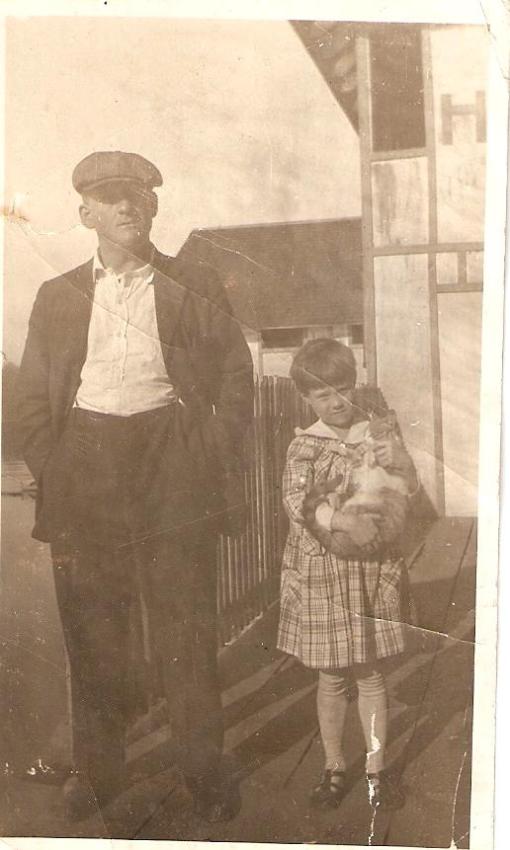
Croop 1 – My cousin Jean (2nd from left) and some friends in front of the Pop Corn stand (Croop’s Glen)

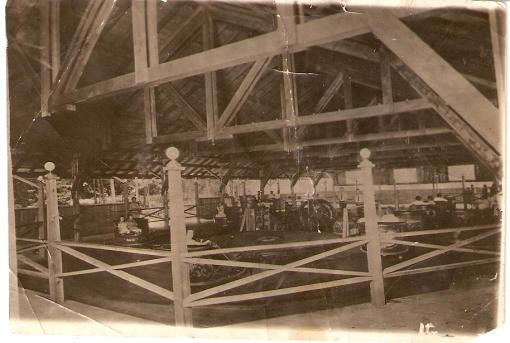
Croop 2 – carousel – photo by Croop’s Glen Art Studio (Croop’s Glen)

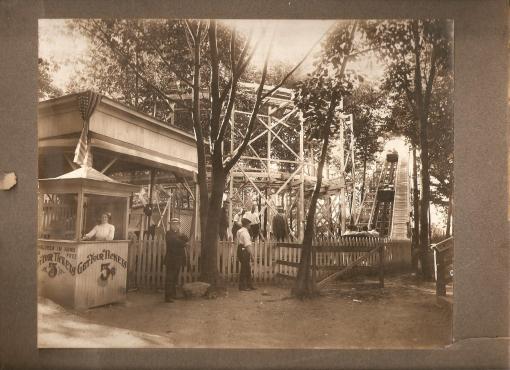
Croop 3 – My cousin Jean selling tickets (Croop’s Glen)

Croop 4 – My cousin Jean as a baby on a carousel horse

A little history. Charles Shelley apparently worked at Harvey’s Lake and built the roller coaster and Shoot-the-Chute. They opened in 1910. He then married Luella Britton (not sure of the exact date). My cousin, Jean was born in March 1912. In 1913, Luella died giving birth to Jean’s little brother (the baby also died). Charles, not knowing how to raise a toddler daughter, hired a live in housekeeper/nanny to help raise Jean. Charles then hooked up with B. Frank Croop and they opened Croop’s Glen and stayed there until it closed in 1940?. Charles Shelley died in 1941 and I think B. Frank Croop died in the next year or two. I know Jean told me she used to sell tickets at the park and worked there as a teenager. Several years ago, we took
her to Knoebel’s and she rode the merry-go-round. She died this past July at the age of 99”–Ellen

Croop 6 – Charles Shelley (Croop’s Glen)

Croop 7 – Jean and Charles Shelley at Harvey’s Lake

Croop 8 – Jean and Charles

Croop 9 – The Whip (Note:  Ellen does not know if this is Croop’s Glen or Harvey’s Lake)

Croop 10 – Jean and unknown man at Harvey’s Lake

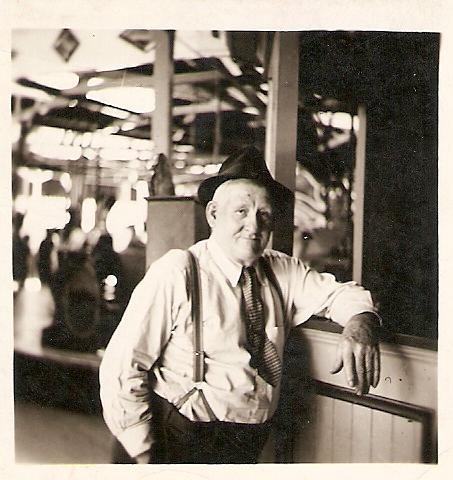
Croop 12 – Charles Shelley (Croop’s Glen)


Croop 13- dance hall? Not sure (Croop’s Glen)

Croop 15 – 4 men working on mechanics of a ride. I think Charles Shelley may be the one
kneeling on the left. This is the photo of a photo and I do not know where it came from. (Could be Croop’s Glen or Harvey’s Lake)

Croop16 – roller coaster. I believe Charles Shelley is pictured in the center looking up (Croop’s Glen)

Croop 50- carousel – Again Charles is in the center looking at the camera.

@@@@@

Thank you Ellen for making our history a little more complete!

@@@@@

More Recent Pictures From Croop’s Glen

&

Baby Contest Pavilion Collapse at Croop’s Glen

facebook

It was Jennifer O’Malia who introduced me to the concept of Urban Exploration

Style Photography in 2010.  Jenn, who has the unique vision of a

social documentarian, is now offering her services as a freelance photographer.

 Photo by Jennifer O’Malia 

Jenn Wedding

Return To

GUERRILLA HISTORY Table of Contents

or

click right HERE for more Croops Glen Updates!