Posts Tagged ‘ Wyoming Valley ’

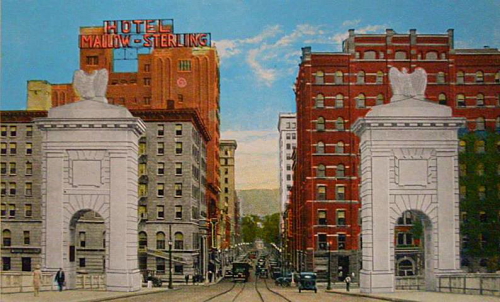
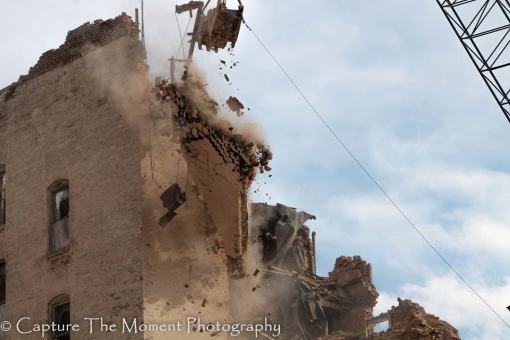
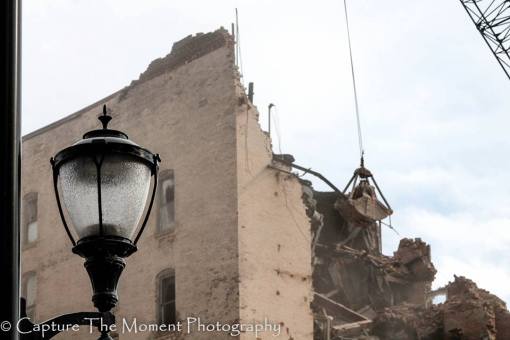
An Anniversary of Decline: The Significance of the Demolition of the Hotel Sterling

Picture 6 2

This is every community’s story in 2016 America. Crazy as it sounds, as you hear residents debate about the possibility of “saving” an abandoned or endangered  building, especially one of historical significance, have you ever considered the issue from the building’s point of view? Now you can, for free (at least from July 27th thru July 29th, 2016) at Amazon.com.

Picture 18 2

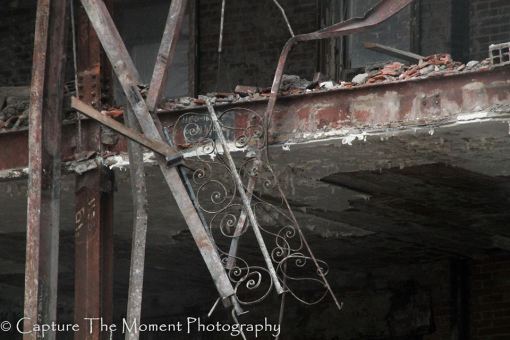
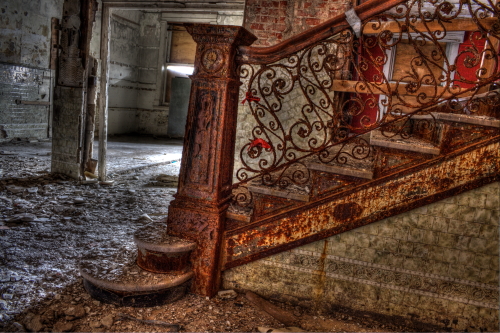
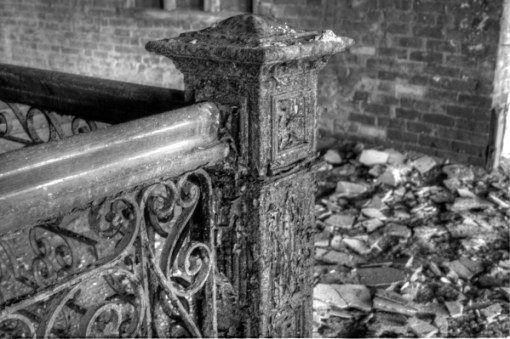
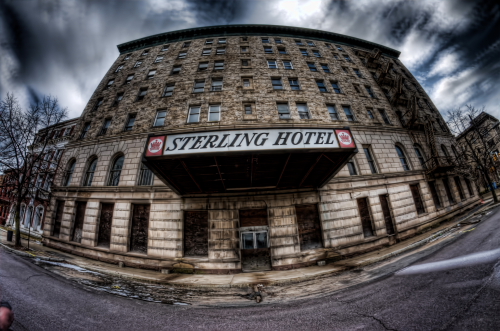
I had the opportunity to photograph what remained of the historical Hotel Sterling, prior to demolition, and I swear, it “spoke” to me–about the price of preservation, and the cost to communities when non-action occurs, while waiting for some unknown entity to step up with a solution and much needed funding.

First published in July of 2013 and currently ranked on Amazon’s Historical Preservation world-wide category at #121**, Welcome To The Zombie Hotel Sterling, will be available for free, in honor of its demolition anniversary, until Friday, July 29th, 2016.

**(Update: Currently #1 in Pop Culture on 7/27/16 & 7/28/16.  Sorry Taylor Swift!  Just kidding, I love Taylor….)

amazon


“History meets Pop Culture in a tale about time, consequence, and unrealized visions for the future, as an entire community attempts to outrun diminished expectations for a way of life they can no longer hope to maintain. Abandoned and rotting away along the banks of the mighty Susquehanna River, the zombified Hotel Sterling tells its tale of fading grandeur and woe to a photographer visiting the deteriorating structure, seeking to document the reality of the condition of the building, as the hotel waits for its beloved community to decide its fate, once and for all.”

So grab a digital copy for yourself, while you can, for free.  If you don’t have a Kindle App, you can get one, for you smartphone, computer, or tablet at:  Amazon Free Kindle App  .

*~*~*~*~*~*~*~*

 What does local Abandoned Pennsylvania History

have to do with the 2016 Presidential Race?

Visit:

Abandoned Scranton Lace:

A Visual Autopsy of The American Dream

facebook

Cheri Sundra © 2016 All Rights Reserved


A Resurrection Reversed: The Playboy Bunnies & The Death(s) of the Wilkes-Barre Train Station (Part 2)

GFoster 1

Photo courtesy of George Foster

(If resurrection is the concept of coming back to life after death, how do you measure the success, or failure, of one?)

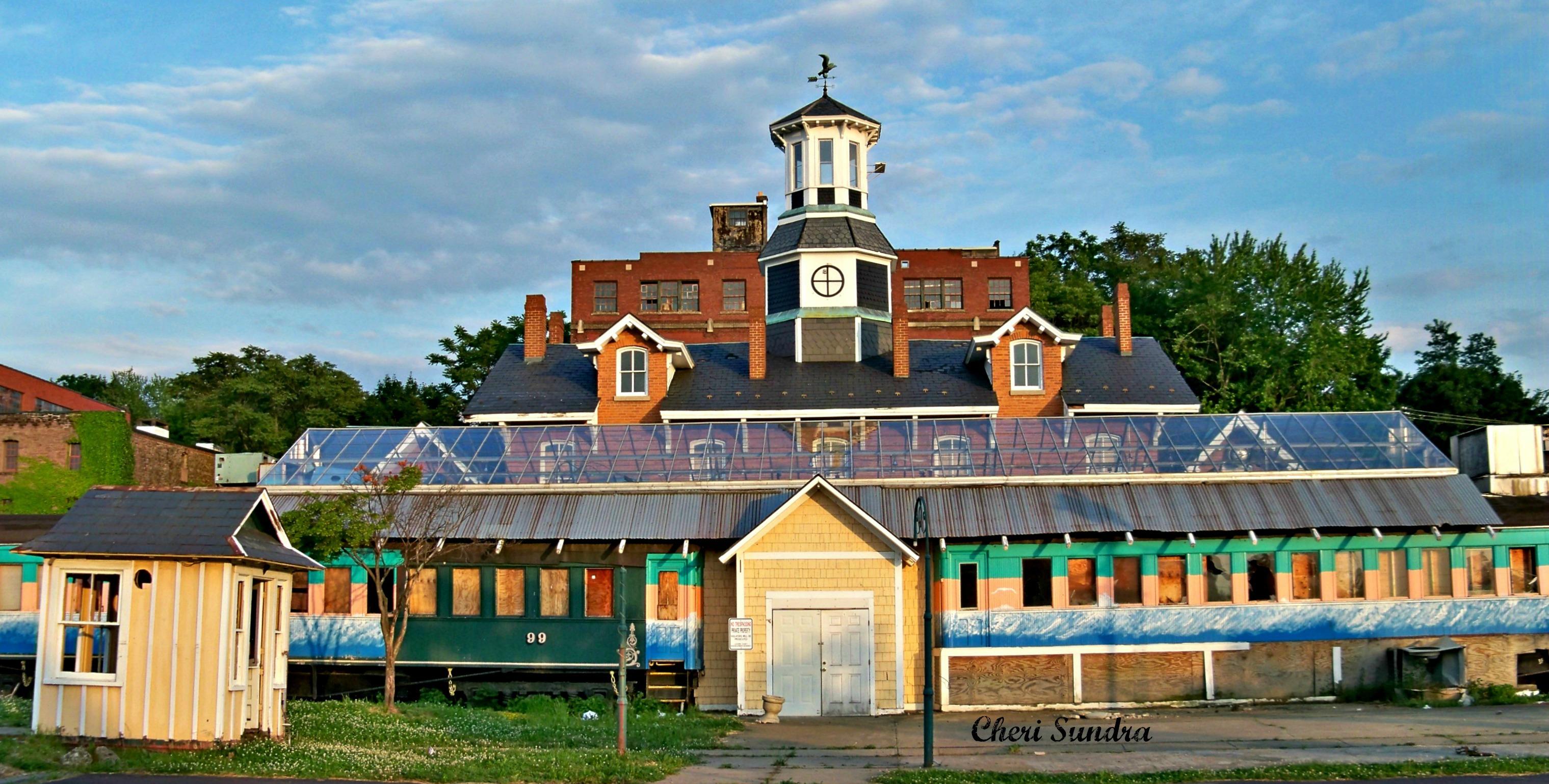
Wilkes-Barre Train Station 2014

Wilkes-Barre Train Station 2014

Some townspeople, in a “has-seen-better-days” place named Wilkes-Barre, Pennsylvania, are looking for someone to save their tragic little train station……again. This is unquestionably a noble goal. But any potential philanthropists, preservationists and “do-gooders-in-general” should be forewarned that this is a community with a history of its own—a history that includes squandering the gift of historic resurrection.

Allow me to photographically illustrate a story that will break your heart. It is a tale about a man with a dream, who invested millions of dollars, in a labor of love, to give the gift of history and heritage back to his hometown.

I’m talking about an old-school, self-made, “no-government-grant-money-needed”, community philanthropist with a vision for the future, who spent his own cash to restore a vacant and quickly deteriorating historical landmark.

What did that community do with the living piece of history that he so lovingly and generously invested in for them to enjoy for years to come?

In an act of betrayal, the town just complacently watched, as the property reverted back into a state of abandonment and ruin once again, very shortly after their benefactor entrusted the train station’s care to other community members. This is a frightening tale about what can happen to history when commercial non-profitability and loss of accountability in local government collide.

Let’s begin our story right here:

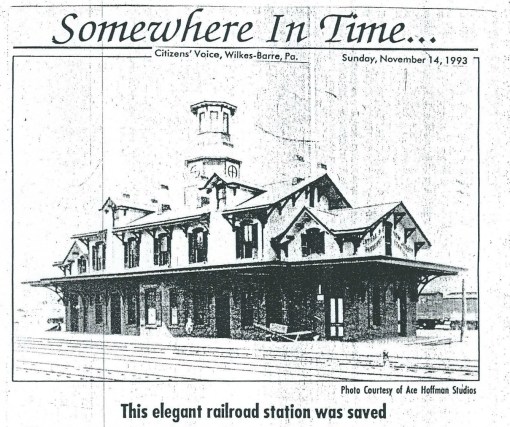
Scan0005a

Once upon a time, many years ago…..in 1974, to be exact…..there was a historic little train station who had seen much better days. After playing a major role in the prosperous years of the fair city that it calls home (See Part 1), this particular train station was viewed as an abandoned building merely existing in a state of ruin, and standing in the way of “progress”. It was nothing but a hopeless abandonment, plagued by vandals, and slated for demolition. The Luzerne County Redevelopment Authority planned to remove the structure, since it was in the direct path of an extension planned to make way for a downtown automobile traffic distributor—whatever that is! But the community stepped up and got involved in trying to rally support for this endangered landmark.

First, there was a Senator named Hugh Scott who urged local communities in Pennsylvania to try to save old rail depots throughout the state so they could serve as museums or something useful.

Then people began writing letters and articles urging the community to save Wilkes-Barre’s little monument to the halcyon days of passenger train service, which usually began with statements such as:

“No longer the trim, ornate passenger station it once was back in the hey-day of rail travel in Wyoming Valley, the Central Railroad depot now is a run-down, dilapidated structure; its boarded-up lower floors, broken windows and mouldering (sic) cupola stand as mute evidence of Wilkes-Barre’s historic past.”

While that newspaper blurb sounds eerily like it could be pulled from 2014, it actually ran in the September 28, 1974 issue of the Wilkes-Barre newspaper! Forty years ago, this community was looking at the SAME train station, in the SAME condition that it sits today, wondering what to do with this magnificent piece of history that sat in ruins. What has transpired in Wilkes-Barre over those four decades is a tale of hope, transformation, and then a decline that should make the business leaders and elected officials in that community hang their heads in shame.

Wilkes-Barre Train Station 2014

Wilkes-Barre Train Station 2014

In 1974, their local newspaper was saying things like:

“Time is running out for the old Central Railroad of New Jersey passenger station, whose 106 years of history cover the major span of the once great railroad industry, second only to anthracite mining as the greatest employer in Wyoming Valley. Now, vacant and deteriorating rapidly since the shutdown of all CNJ service in Wilkes-Barre on March 31, 1972, the historic building awaits its fate. “

What happened next was nothing short of miraculous in the world of historical preservation! It was almost inconceivable that anyone would really be interested in salvaging such a deteriorating structure, especially since its small size mitigated against any otherwise major redevelopment that could grace the seven acre tract of land that it sits upon.

DSC_1353

Photo courtesy of George Foster

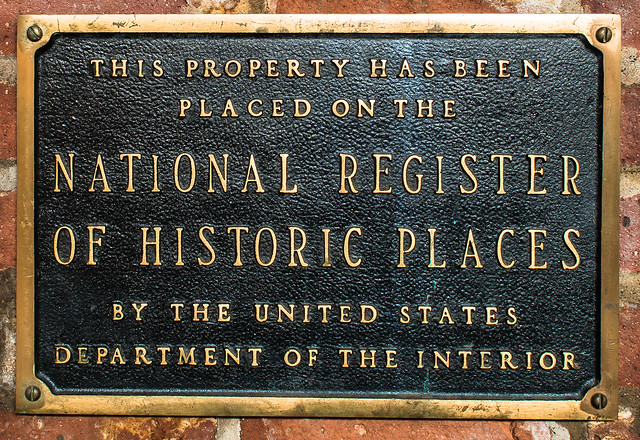
But against all odds, amazing things happened! The Greater Wilkes-Barre Jaycees took on the responsibility to get the ball rolling. They organized a “Save Our Station” committee and embarked on a quest to secure “historical landmark” status for the structure. They didn’t have the resources or knowledge required to do the restoration job themselves, but they were successful in having that little train station placed on the National Register of Historic Properties and the Pennsylvania Register of Historic Sites and Landmarks. Now all that the story needed was a hero to save the day! And that’s when a man named Marvin Roth came to the rescue.

Marvin Roth & His Restored Train Station

Marvin Roth & His Restored Train Station

Mr. Roth was a novelty and toy wholesaler who grew up a block from the train station, watching the trains come and go. He decided to re-create the hustle and bustle of the busy rail terminal, without involving actual train travel and the end result was a unique motel, restaurant and bar experience.

“I didn’t want the railroad to disappear entirely from Wilkes-Barre, and this is my way of keeping it alive,” he said in a 1987 Los Angeles Times interview about his project to convert the abandoned station into a useful parcel of real estate once again, as a gift to his economically struggling hometown.

Before Mr. Roth stepped up, the elegant brick station had been last used by the Central Railroad of New Jersey, successor to the old Lehigh, Lackawanna, Delaware & Hudson, and Pennsylvania railroads that served the area into the early 1960s after Wilkes-Barre’s coal mines, flooded by the Susquehanna River, stopped operating.

Passenger rail service, which started there in 1843, ended July 1, 1963. Next the station was subjected to the ravages of time and weather, in addition to the day-to-day destruction inflicted by vandals who shattered glass, destroyed moldings, and pilfered valuable and difficult–to-replace originals. The structure was so devastated in the 1972 flood caused by tropical storm Agnes that the local Redevelopment Authority planned to raze it.

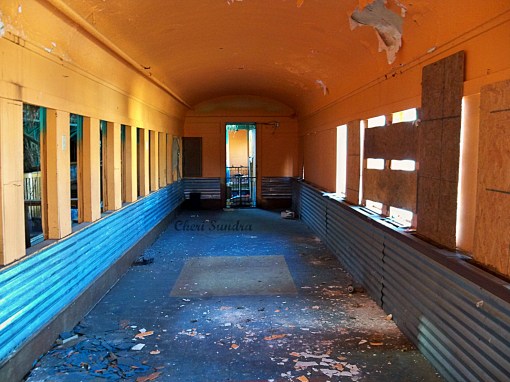
Marvin Roth purchased the train station in late 1977 and embarked upon the kind of successful redevelopment project that everyone hopes to achieve as an end result. He filled the tracks with dining, parlor and sleeping cars, cabooses and freights, using them as a means to add extra commercial space to the tiny train station. Finding the old railroad cars was easy, but getting them into Wilkes-Barre, where track had been torn up, proved to be quite difficult.

Roth Restored Railroad Car

Marvin Roth Restored Railroad Car

Railroad Car Post-Roth- Restoration

Railroad Car Post-Roth- Restoration

“We had to lay track from the site to some freight lines still operating,” Mr. Roth told the LA Times. “That’s how we were able to move a private coach once used by Henry Flagler, the owner of the old Florida East Coast Railway and a partner of John D. Rockefeller.”

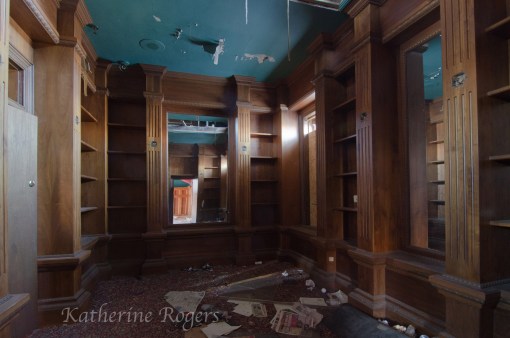
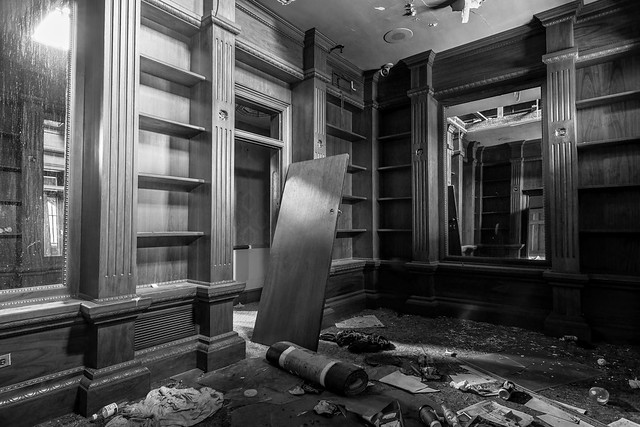
In local newspaper interviews, Marvin Roth was hailed for his “restless search for historically significant artifacts” to place throughout the complex, which included the acquisition of an enormous hand carved sideboard from the Vanderbilt home to be used as the focal point of the lobby. And there was detailed work underway on the train station’s second floor where a cabinet maker from Israel—Nissim Rabbe—labored for months in a room named the “Library Room” , creating walls made out of fine, hand carved walnut.

Marvin Roth Library Room

Marvin Roth Library Room

Library Room Post-Roth- Restoration

Library Room Post-Roth- Restoration

Photo courtesy of Katherine Rogers

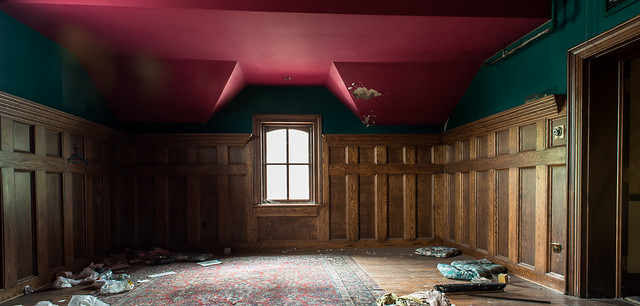
The adjacent room, named the “Billiard Room” because of its large billiard table, was another dining area decorated with stately oak. Newspaper articles went to great lengths to describe how “little expense was spared in selecting appointments, furnishings and decorations to be consistent with the Victorian era in this non-rolling railroad complex.”

The Once Grand Room.

“Billiard Room” Post-Roth-Restoration

Photo courtesy of George Foster

In an interview about his restoration project for the Revel R.R. Resister, Roth “dwelled on his commitment to authenticity in the restoration—even to the tin and copper roof being replaced with all copper.”

In 1979, the local paper declared:

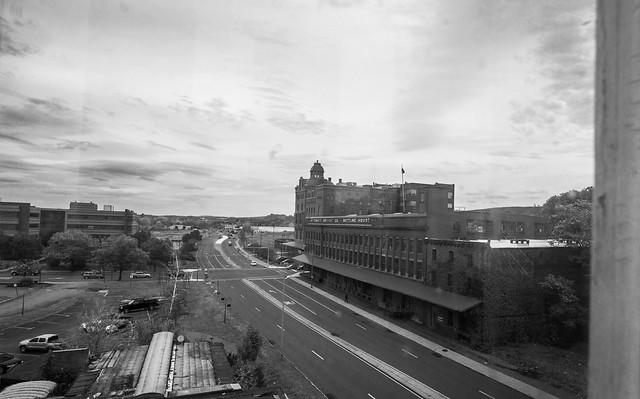
“Perhaps the grandest part of the station is the cupola; Roth said before restoration, the cupola had no access. “When we got up here for the first time we found that the only others ever up here were the pigeons”, mused Roth. From the cupola, one is afforded a grand view of the city.”

DSC_2827

The View–Photo courtesy of George Foster

Mr. Roth continued, “Also, when standing at the top of the grand structure, the new clean slate and copper roofing on the station is eye-catching. “–Citizens’ Voice, April 27, 1979

Sign For Potential Copper Thieves, Post-Roth- Restoration

Sign For Potential Copper Thieves, Post-Roth- Restoration

(Note to readers: Early in 2013, thieves successfully removed the copper roofing material.)

Roth described the cupola as “pure gingerbread” because it served no purpose, but anyone entering it would be unlikely to forget it because it was completely lined with cedar wood.

Cedar Lined Cupola

Cedar Lined Cupola

Marvin Roth did considerable research to find out what he needed to restore the former New Jersey Central Railroad Station. He enjoyed spending the time, money and effort that he put into the project. In a 1979 interview, Mr. Roth said that when he completed his restoration project, that the station would be the showplace of Northeast Pennsylvania. “The bottom line of this project is that it’s not profit oriented. And I look upon this project as being owned by the people of Wilkes-Barre.” OWNED by THE PEOPLE of Wilkes-Barre….

Scan0003Marvin Roth checking details

Post-Roth-Restoration

The Station: Post-Roth-Restoration

Roth’s efforts paid off tremendously and the site quickly became a hot-spot enjoyed by community members of all ages. In January of 1981, The Citizens’ Voice, in a recurring section called “Up with Teens” declared, “The Station is Alive”!

The article went on to describe The Gandy Dancer Room, which featured both live bands and DJs. The venue was fully equipped with lights, sirens and a moving iron horse where, “teenagers danced disco to the latest tunes.” And as Generation X-ers may recall today, “There was a cover charge for the disco when a band played, and you had to be 18 to enter.”

The Station: Post-Roth- Restoration

The Station: Post-Roth- Restoration

There were pinball machines and Space Invaders if you didn’t like to dance. Or you could have a nice quite meal in one of the box cars, which were neatly designed like they were during the Golden Era of Railroad travel. Each car had a dining table, mirror sink and some even had a pull-out bed.

Station Railroad Car: Post-Roth-Restoration

Station Railroad Car: Post-Roth-Restoration

Or patrons could choose one of the dining areas upstairs. The most popular room was the “Bullet Hole Room” which was rumored to have the actual mirror Jesse James was standing in front of when he was gunned down by the Ford brothers because of the $10,000 reward that was on his head. The crack in the mirror is said to be from the bullet that killed him.

The Marvin Roth Bullet Hole Room

The Marvin Roth “Bullet Hole Room”

The Marvin Roth Station

The Marvin Roth Station

The Station Post-Roth- Restoration

The Station: Post-Roth- Restoration

The Station: Post-Roth- Restoration

The Station: Post-Roth- Restoration

By the time renovations were complete, there were more than 60 railroad cars on the site that Mr. Roth named the “Choo-Choo Inn”. It provided 90 private rooms for overnight accommodations. Inside were brass beds, Victorian-style furniture and overhead fans. In 1987, the tab for a night in a restored rail car was less than $50. In an interview from the same year, Mr. Roth said “people love the overnight stay in the ambiance of our sleeping cars. It’s an experience they like to recount to their friends and relatives back home.”

To further explain the ambience, The Los Angeles Times ended the article with:

“The depot, called The Station, is used for dining and dancing. Its freight platform was converted into a tavern called “Gandy Dancer” after track workers, making it one of Wilkes-Barre’s most unusual night spots. Outside The Station entrance is an old red-and-white crossing watchman’s shanty and nearby, a signalman’s tower. A side-tracked locomotive now and then sounds its whistle to reacquaint visitors with what used to be.”

The Station: Post-Roth- Restoration

The Station: Post-Roth- Restoration

Then in December of 1987, The Playboy Steakhouse, with a licensing arrangement with Playboy for an undisclosed fee, opened at the Station Complex, employing 30 women as Playboy Bunnies.

(Admit it, if you are from Wilkes-Barre and part of Generation X or later, you are thinking “We had freakin’ Beer, Peanuts, the Golden Era of Train Travel AND an internationally known concept like Playboy Bunnies, which still enjoys tremendous popularity today?!….how did we NOT become a tourism hot-spot?” Mr. Peanut Guevara  is still waiting for The Revolution to begin…..)

During the 1960s and 1970s, Playboy Clubs were considered the height of citified elegance – or at least opulence. In a 1988 interview, Station manager Jack Cantor said, “We were looking for a new concept to liven up the place. Wilkes-Barre had only read and heard about Playboy clubs. Now we have the concept here.”

“We just want to be brand-new in every way,” said Robert Habeeb, the Steak House’s director of food and beverages, in that same interview. “It’s a revival of the Playboy idea, in a popularly priced restaurant, for the general public. Look, like Philadelphia, Wilkes-Barre has the image of being a little prudish,” said Habeeb. “When Playboy clubs were at their height, it never would have flown here. We’re ready for this kind of thing now. The Playboy standard of service is something this town has never seen.”

Apparently, not everyone in the small town was ready to embrace the Playboy Bunny-themed affordable restaurant. “We had a local minister writing lots of letters to the newspapers when we started hiring bunnies in November and we got a little flak when we opened because it was in the middle of the Jessica Hahn deal,” admitted Habeeb in that interview. Ironically, newspaper accounts mentioned the local desire to attract other “themed” restaurants, such as Bennigan’s, to act as “tourist magnets” instead of the Playboy franchise.

The Playboy Steakhouse days in Wilkes-Barre were short lived. Just six months later, in June of 1988, Thom Greco, Rick Kornfeld and Mitch Kornfeld entered into a lease-purchase agreement with Marvin Roth’s Revel Railroad Company, which operated the Station Complex. (Two years later, Marvin Roth suffered a heart attack and died) Shortly afterward it became very apparent that they did not support Roth’s vision for the facility at all. First they banished the Bunnies.

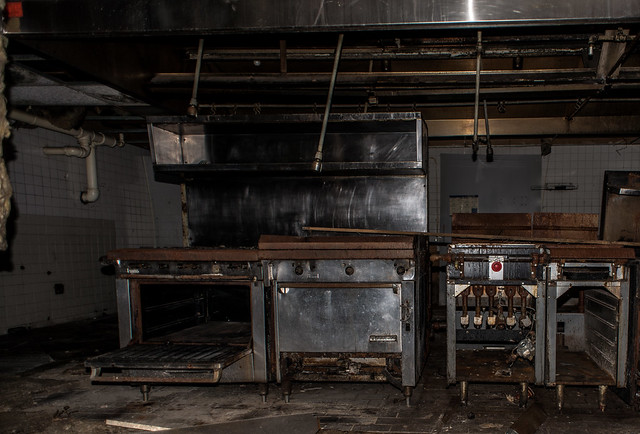
Grimy Kitchen The Station Kitchen: Post-Roth-Restoration

Photo courtesy of George Foster

The new owners said the image change would not only recognize the emergence of feminism but would also broaden the establishment’s clientele. “A lot of times, husbands would stay in the rooms,” Mitch Kornfeld said, “and wives would call up and say, ‘You’re staying in the Playboy club?”

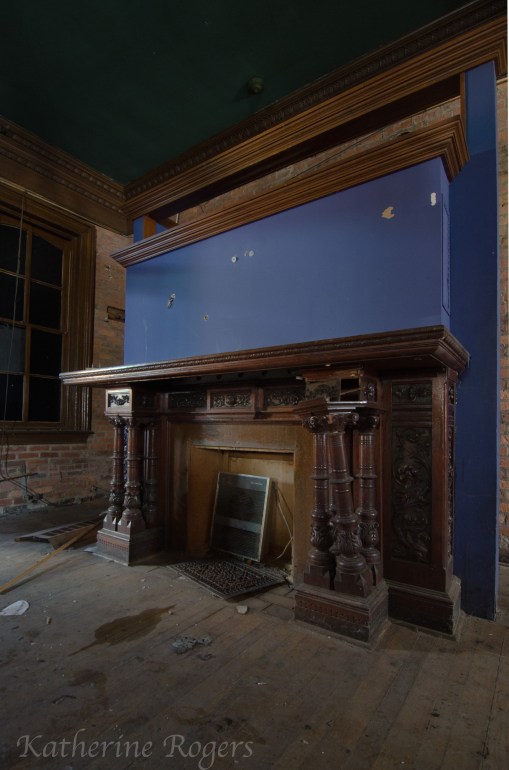
The Station: Post-Roth- Restoration

The Station: Post-Roth- Restoration

Photo courtesy of Katherine Rogers

In June of 1988 Mitch Kornfeld told the Inquirer, “It didn’t work in New York or Chicago, why would it work in Wilkes- Barre? It’s a little passé. If we were in the late ’70s it would work, but we’re in the ’80s. Women are just different. People are different.”

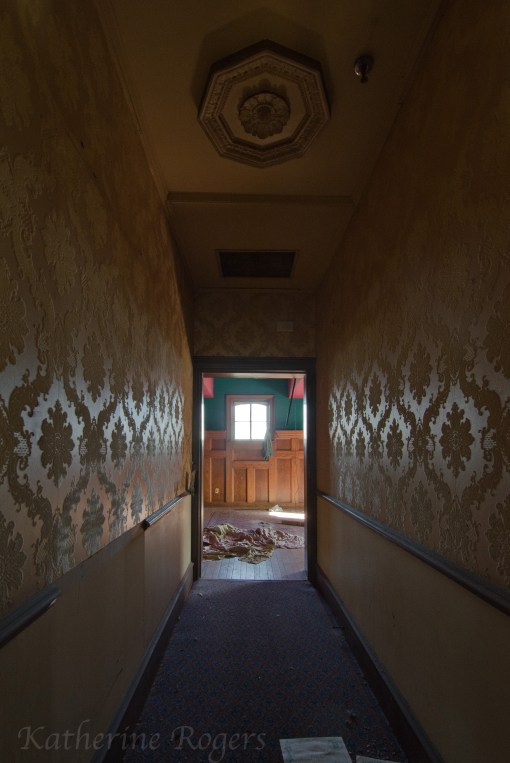
The Station: Post-Roth- Restoration

The Station: Post-Roth- Restoration

Photo courtesy of Katherine Rogers

The new owners decided to get rid of the Playboy franchise in order to open a new restaurant and nightclub called Norma Jeane’s. They renamed the entire facility Market Street Square. The complex remained open through the 1990s, touting a succession of different nightclub and restaurants names, with none of them ever really becoming successful ventures. At least not successful enough to keep the place open for very long.

The Station: Post-Roth- Restoration

The Station: Post-Roth- Restoration

Photo courtesy of the League of Gentlemen Explorers

In 1991, The Morning Call reported that the new owners were experiencing some drawbacks attributed to having 90 guest rooms in train cars. “The cars are narrow, require a great deal of maintenance because they are exposed to weather, and are expensive to heat and cool. Also, guests have to go outdoors to get from their rooms to the restaurants, nightclubs or lobby. Some older people don’t like having to use steps to get to their rooms.”

Recently Removed Railroad Dining Car: Post-Roth-Restoration

Recently Removed Railroad Dining Car: Post-Roth-Restoration

The Kornfelds walked away from the business arrangement in 1992, while “entertainment magnate” Thom Greco remained involved. By 1994, the “Choo-Choo Inn” was closed for good. The entire complex shut down completely in 2001, just 24 years after Marvin Roth rescued the train station from demolition by purchasing the property it sits on for $80,000, and investing more than $3 million dollars of his own money into restoration.

The Station: Post-Roth- Restoration

The Station: Post-Roth- Restoration

Photo courtesy of the League of Gentlemen Explorers

In 1999 it was reported by the Times Leader that within that past year, city firefighters were often called to put out fires at the abandoned “Choo-Choo Inn” because homeless squatters were igniting items to keep warm, or vandals were setting fires inside the cars. In an interview at that time, Fire Chief Bruce Reilly said that he’s afraid one of his firefighters will get hurt responding to those train car fires. “Some have Plexiglas windows,” he said. “You can’t bust them. Every time they get boarded up, somebody breaks into them.”

Recently Removed Railroad Car: Post-Roth- Restoration

Recently Removed Railroad Car: Post-Roth- Restoration

The mayor at that time, Tom McGroarty, who seemed ambivalent about the history of the property in newspaper interviews, just wanted the cars removed. A youngster when the motel first opened, the mayor stated in 1999 that he only “kind of” remembers the inn and described the area as nothing but a mess. He gave Greco until October of 2002 to remove the train cars from the property.

On March 30, 2002, according to the Citizens’ Voice, Greco was still looking for new owners for the splendid rail-cars that Mr. Roth so carefully restored as a gift to the citizens of Wilkes-Barre. He had to clear the property and pay off back-taxes. The cars were now “eyesores, attractions for the homeless and fire hazards”, according to the newspaper.

Greco noted that a great deal of money had gone into renovating the railcars to bring them back to their historical nature. “When we closed the hotel”, he said in that interview, “they were in perfect shape. We didn’t put the graffiti on them, set fires or steal from the rooms. We once had a historic area”, he added, “Unfortunately, the railcars ended up in this condition because the people here destroyed them. They were redone and the community destroyed them.” It should also be noted that Greco obviously did very little himself, as the owner, to protect these treasures in his possession from vandals, thieves and homeless people, who don’t exactly view themselves as part of “the community”.

Today, for the second time in history, the fate of the little train station (which again sits abandoned, in ruins, unsecured, plagued by vandals and quickly deteriorating) is back in the hands of the Luzerne County Redevelopment Authority— just like it was, pre-Marvin Roth Rescue.

The Station: Post-Roth- Restoration

The Station: Post-Roth- Restoration

Photo courtesy of Katherine Rogers

In 2006, the Luzerne County Redevelopment Authority purchased the property from Thom Greco, becoming its owner for the second time using $5.8 million in taxpayer funded federal community development money. Since this is Northeastern Pennsylvania, where nothing seems to occur in local government without a scandal, the deal also included $10,000 in the form of television sets that were allegedly a “reward” from Greco to a county commissioner for his influence in making the sale happen. The TVs were to be used in a family owned sports bar and led to all kinds of legal implications for the people involved.

The Station:  Post-Roth- Restoration

The Station: Post-Roth- Restoration

Photo courtesy of the League of Gentlemen Explorers

A recent appraisal of the property estimated that it is now only worth about $1.88 million, which is significantly less than what the county paid to acquire it.

The Station:  Post-Roth- Restoration

The Station: Post-Roth- Restoration

Photo courtesy of the League of Gentlemen Explorers

Current plans for the train station include seeking a commercial real estate firm to market the historic property. In 2012, county manager Robert Lawton said he did not support a prior county decision to spend $2 million renovating the station. He asked the redevelopment authority to consider selling the train station and adjoining properties to a private owner (again). The Authority opened a competitive bidding period on the property. They received absolutely no offers from anyone.

Last July, Wilkes-Barre demolished another landmark structure, the Hotel Sterling, after a failed, government-funded attempt to preserve and market the structure.

Time is quickly running out (again) for the little train station in Wilkes-Barre. The current owner obviously cannot afford to even secure the property from further vandalism since the extent of their security measures begins and ends with a maintenance worker checking the property, along with other rail properties on “most days”, according to reports in the Times Leader.  It is speculated that homeless people currently use the building for shelter during inclement weather. There are also an awful lot of feral cats living there.

Cat Pan at The Station:  Post-Marvin-Roth-Restoration

Cat Pan at The Station: Post-Marvin-Roth-Restoration

Photo courtesy of the League of Gentlemen Explorers

Post-Marvin Roth Restoration, we live in a different age now, when historic preservation projects are often viewed as “money grabs” by developers nationwide just seeking to exhaust government grants before the buildings are ultimately demolished, just like the Hotel Sterling, simply because there rarely seems to be enough funding available to complete these kinds of projects in their entirety, without additional funding from private sources.

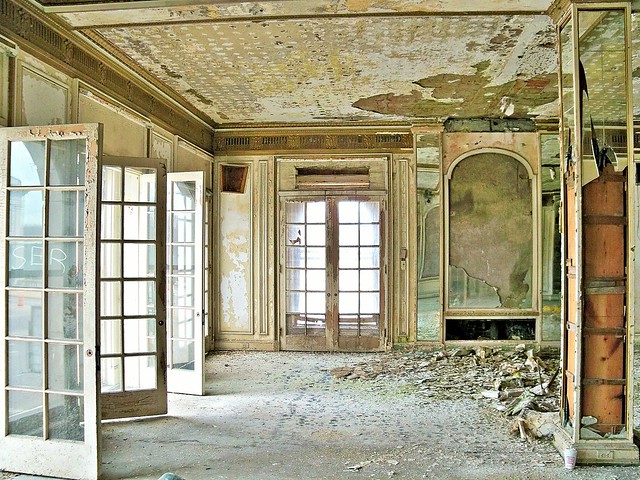
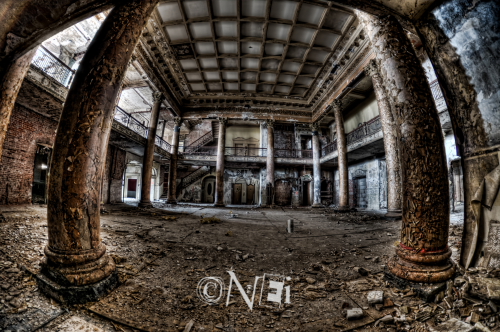
Zombie Ballroom at the Hotel Sterling

Zombie Ballroom at the Hotel Sterling

Cheri Sundra–Guerrilla Historian

When Marvin Roth purchased the train station while it was endangered the first time, he said, “I bought it because I was infatuated with the building, and I made it my hobby. I never went into it as a money maker. It’s not a business.” Unfortunately, for the train station, it ultimately ended up in the care of community members who were ONLY interested in the bottom line and nothing else.

Marvin Roth Wilkes-Barre Historical Train Station Restoration Project

Marvin Roth Wilkes-Barre Historical Train Station Restoration Project

Sadly, there just aren’t many people in the world like Marvin Roth. I wish my hometown had better managed his efforts to save our history when we had the chance.

Historical structures are lucky to get saved once, what are the chances that it can happen twice?

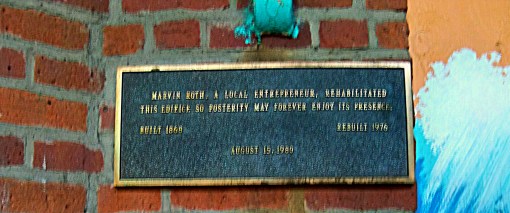
Sign 2

The sign reads:

MARVIN ROTH, A LOCAL ENTREPRENEUR, REHABILITATED THIS EDIFICE

SO POSTERITY MAY FOREVER ENJOY ITS PRESENCE.  AUGUST 15, 1980

The Station:  Post-Roth-Restoration

The Station: Post-Roth-Restoration

Photo courtesy of Katherine Rogers

~*~*~

The Station:  Post-Roth-Restoration

The Station: Post-Roth-Restoration

Photo courtesy of the League of Gentlemen Explorers

~*~*~

The Library

The Station “Library Room” :  Post-Roth-Restoration

Photo courtesy of George Foster

~*~*~

The Station:  Post-Roth-Restoration

The Station: Post-Roth-Restoration

 ~*~*~

The Station:  Post-Roth-Restoration

The Station: Post-Roth-Restoration

 ~*~*~

The Station:  Post-Roth-Restoration

The Station: Post-Roth-Restoration

 Photo courtesy of Katherine Rogers

~*~*~

The Station:  Post-Roth-Restoration

The Station: Post-Roth-Restoration

 ~*~*~

The Station:  Post-Roth-Restoration

The Station: Post-Roth-Restoration

 ~*~*~

The Station:  Post-Roth-Restoration

The Station: Post-Roth-Restoration

~*~*~*~

The Station:  Post-Roth-Restoration

The Station: Post-Roth-Restoration

 ~*~*~

The Station:  Post-Roth-Restoration

The Station: Post-Roth-Restoration

~*~*~

The Station:  Post-Roth-Restoration

The Station: Post-Roth-Restoration

~*~*~

The Station:  Post-Roth-Restoration

The Station: Post-Roth-Restoration

~*~*~

The Station:  Post-Roth-Restoration

The Station: Post-Roth-Restoration

~*~*~

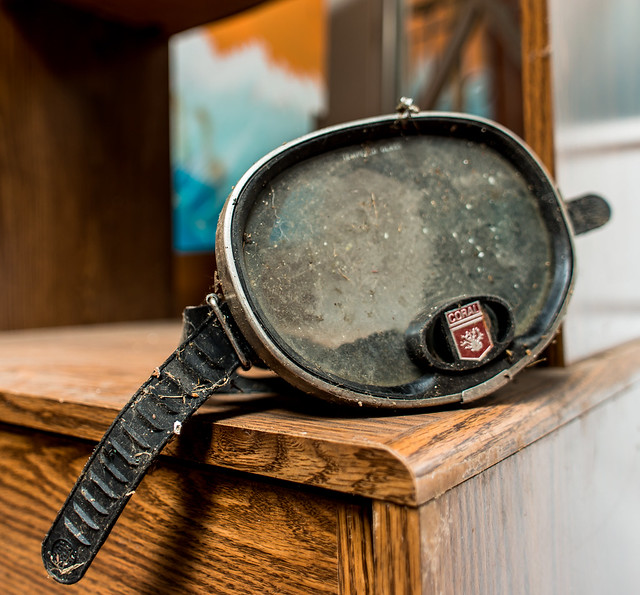
Scuba

The Station:  Post-Roth-Restoration

Photo courtesy of George Foster

~*~*~

The Station:  Post-Roth-Restoration

The Station: Post-Roth-Restoration

 ~*~*~

The Station:  Post-Roth-Restoration

The Station: Post-Roth-Restoration

~*~*~

DSC_1345

The Station:  Post-Roth-Restoration

Photo courtesy of George Foster

~*~*~*~

The Station:  Post-Roth-Restoration

The Station: Post-Roth-Restoration

~*~*~

The Station:  Post-Roth-Restoration

The Station: Post-Roth-Restoration

~*~*~*~

The Station:  Post-Roth-Restoration

The Station: Post-Roth-Restoration

~*~*~

The Station:  Post-Roth-Restoration

The Station: Post-Roth-Restoration

~*~*~*~

The Station:  Post-Roth-Restoration

The Station: Post-Roth-Restoration

~*~*~

The Station:  Post-Roth-Restoration

The Station: Post-Roth-Restoration

~*~*~

The Station:  Post-Roth-Restoration

The Station: Post-Roth-Restoration

~*~*~*~

The Station:  Post-Roth-Restoration

The Station: Post-Roth-Restoration

~*~*~*~

The Station:  Post-Roth-Restoration

The Station: Post-Roth-Restoration

Photo courtesy of George Foster

 ~*~*~*~

facebook

RETURN TO

GUERRILLA HISTORY TABLE OF CONENTS

Cheri Sundra © 2014
All Rights Reserved

Hotel Sterling: History Deconstructed

Hotel Sterling:  History Deconstructed

Whose Version of History Gets to be Saved?

3

Featuring a “Grand Luxury” Finale

of Hotel Sterling Demolition Photography

by Steve Woitkowski of

Capture the Moment Photography Studios

9

The definition of “history” is the past considered as a whole.  So until last week, the Hotel Sterling wasn’t “history”, it was actively part of the present.  The Hotel Sterling was still a “verb” in our community. 

This is what I find myself contemplating:   Considering that since 1964 the building had seriously declined way past the point where it was even being used as a hotel, which historical version of the building were historians and preservationists trying to “sell” to us as part of our collective history?

And, more importantly, whose history were they actually telling with that version?

Are there more people alive today, who have experienced the Hotel in the way that its history was being packaged for consumption, or do the majority of Luzerne County residents who are still alive, have a much different, and more important, history to recall about the Hotel Sterling?

To me, as an Urban Explorer, documenting the fallout from the financial decline of our community, it represents something MUCH different than a fancy Grand Luxury Hotel where people used to dine in The Palm Room, and dance the night away in the ballroom.

It's a Zombie Ballroom now at the Hotel Sterling

To most people in Generation X, Generation Y and whatever generation we are at now, the decrepit Hotel Sterling has never been anything close to that vision for them either.  In fact, for more than HALF of the years in the “life” of the Hotel Sterling, it looked NOTHING like the image that preservation proponents were trying to spoon-feed to the public.

Sterling 6

Sterling 2

For the majority of her years as a part of Luzerne County’s history, the Hotel Sterling was not THAT hotel being portrayed by preservationists—that “history” is only true for the years occurring between 1897 and 1949, which is only 52, of the Hotel Sterling’s 116 years, as a part of the Luzerne County community.

Then from 1949 to the day demolition began, 64 YEARS LATER, the reality is that the Sterling existed as a downgraded, community-centric version of its former self, until it eventually declined to the point of existing as a mold infested, water damaged, hunk of derelict, community resource pillaging,  real estate for the last few generations of Luzerne County residents to experience in the physical form.

How do you really interpret “collective history” when everyone’s experience, even of the physically present, can be so vastly different?  How do you ultimately decide whose “history” is most important to consider, and what gets to be documented, remembered and revered?

Sterling 7

Whose story gets to be told—the living or the dead?  The rich or the poor?  The young or the old?   And how long is it OK to put off creating the history of the future, in order to attempt to save the history of the past?

Sterling 9

I take real issue with people trying to sell any community on an historical preservation attempt that may not necessarily be in their best financial interest, based upon the assertion that buildings somehow ARE the heart and soul of that community.  Buildings and institutions are often more exclusionary in nature, than inclusive.   And I don’t mean that these places openly segregate community members in an overt fashion.  I’m talking about the kind of subtle socioeconomic based exclusion, that often goes unacknowledged by the people doing the excluding, but is felt at a core level by those being excluded.

Sterling 8

Obviously, the more affluent classes had wider access to the Hotel Sterling during its prime years as a Grand Luxury Hotel.  It was ultimately constructed strictly for the purpose of meeting the needs of the elite and business classes, while they were here in Luzerne County, exploiting the lower classes for profit. Working class people didn’t have the financial or social privilege of accessing that “string orchestra/Lobster Thermidor” version of the Hotel Sterling nearly as often as the wealthy got to have it.  The coal miners, for example,  with their dirty clothing and soot covered faces couldn’t belly up to the bar on their way home from work, to throw back a few beers, next to the same kind of people who were exploiting them for profit.

Sterling 3

Sterling 1

Sure as the “Grand” version of the Hotel began to slowly devolve, it became more inclusive to a larger portion of the Luzerne County community, as a venue for social club meetings and high school graduations.  More people of a different class structure began mingling at the bar. 

Sterling 4

And as the decline to eventual abandonment continued, the now decrepit Hotel Sterling became low income housing for the elderly, including some of those coal miners.  But much like the version of the Hotel Sterling that they lived in then, the retired coal miners were also slowly dying, because of the now diseased lungs that were inflicted upon them, as they worked for the people for whom the very Hotel Sterling was constructed,  for use as a Grand Luxury Hotel, and then cast aside, like the workers themselves, when no longer useful.

Sterling 5

Hotel Sterling Lobby During the 1972 Agnes Flood

And even at that point, a large portion of the Luzerne County population was STILL excluded from access to the now decaying Hotel Sterling,  based upon a different set of socioeconomic and age restrictions.  Until the day came when the doors closed for one last time, and an entire generation went through life in Luzerne County, with no active access to the Hotel Sterling whatsoever.  At least not by walking through the front door!  😉

Abandoned Hotel Sterling: The Harsh Light of Day

The Harsh Light of Day

Cheri Sundra–Guerrilla Historian

Actually, you could make a strong argument for the fact that the Hotel Sterling has robbed Generation X and Generation Y , of their own shot at experiencing a “Grand Luxury” version of their community and their future, because a blighted structure, with little hope of successful redevelopment, lingered for too long, on a prime parcel of real estate, impeding future economic growth in their hometown.   THAT’S the version of history that ALL of us will recall about the Hotel Sterling, and unfortunately, it’s the history that will have the most impact upon Luzerne County’s future.

Picture 23

Sterling

6

Photo Credit:  Steve Woitkowski

2

Photo Credit:  Steve Woitkowski

1

Photo Credit:  Steve Woitkowski

5

Photo Credit:  Steve Woitkowski

4Photo Credit:  Steve Woitkowski

7

Photo Credit:  Steve Woitkowski

8

Photo Credit:  Steve Woitkowski

10

Photo Credit:  Steve Woitkowski

~*~

Return To Guerrilla History

TABLE OF CONTENTS

Cheri Sundra © 2013
All Rights Reserved

The Hotel Sterling: Five History Lessons

The Hotel Sterling: Five History Lessons

(What is history REALLY telling us?)

Featuring the photography of Dawn Robinson & Stacy Shannon

With Ed Mountjoy of The Forgotten Places of NEPA, who ultimately  gets the last word!

DawnPhoto Credit: Dawn Robinson of Nocturnal Echo Imagery

About a decade or so ago, it was trendy in declining communities to sell people on the notion that historic preservation was the ticket to imparting eternal life. But as the literature of those who try to cheat death has shown us, the bid for immortality can come at a huge price.  While the walking dead may be all the rage in pop culture, no city wants to find itself plagued by zombie buildings, a term being adopted nationwide to describe the disease afflicting places where buildings are difficult to lease, or sell, because they are in physical disrepair, and their owners lack the resources to bring the building up to code .  Unfortunately, using millions of taxpayer dollars that were supposed to be spent on our city’s financial resuscitation, it appears that Wilkes-Barre has created a Zombie Hotel instead. 

The demolition of the once grand Hotel Sterling really only leaves one question–Why?  Why do beautiful things fall to disrepair?  Why did our community allow this place, with such a romanticized past, fall to ruin?  Why did this beloved building turn into a memento mori of Wilkes-Barre’s prosperity?  

StacyPhoto Credit: Stacy Shannon

Every time a historical landmark is left to die, a community is left   to confront failure.  The building failed to live up to expectations, the owners failed to maintain the structure, and  the community leaders failed to create a local market that could sustain successful business development.   Sadly, happy stories of rehabilitation and rescue are few and far between for the majority of places across the nation.  Instead the failure to preserve historic landmarks seems to be serving as the signal of the kind of economic collapse that begins with the start of a zombie building apocalypse in struggling communities nationwide.

Northeastern Pennsylvania’s three largest cities, including Wilkes-Barre, are currently standing on the ledge, looking into the abyss of financial failure.  Decades of arbitration-mandated labor-related costs are rising faster than tax revenues, large numbers of untaxed buildings are owned by nonprofits, and stagnating tax bases are deeply rooting these communities into the same dire financial situation that has contributed to the total collapse of cities like Detroit and Camden. 

Dawn 1

Photo Credit: Dawn Robinson

About a decade ago, Wilkes-Barre’s leaders presented our community with a big plan that was supposed to save it from the same fate facing her two sister cities–Scranton and Hazleton.  This agenda, primarily consisting of historic preservation, was called the “Susquehanna Landing” project.  The plan included a newly renovated Hotel Sterling packed with shiny new residential units.  There would be yet another city parkade built which would somehow become part of the Luzerne County owned, and still vacant, Springbook Water Company, located behind and to the right of the Hotel Sterling.  There would be a museum in the still vacant Sterling Annex building,  which would connect  via some elaborate, elevated walkway system, to some newly built conference center that would somehow be linked to the still vacant Irem Temple, which is currently owned by the Chamber of Commerce. 

What was ultimately missing from this plan was a NEED for all of this redevelopment in the first place.

Hotel Sterling Historical Lesson #1—Create a Need

You construct your vision around a need that already exists.  You don’t attempt to build something that you hope will create one.  When the Hotel Sterling was built, droves of immigrants were motivated to cross the ocean to come to Luzerne County to work in our mining industry.  Coal was King and trains were depositing, and retrieving, large gatherings of business men at the train station on a daily basis.  It was because of this activity, that the Hotel Sterling was actually constructed.  These people needed somewhere to sleep, have meetings and entertain while visiting Wilkes-Barre for business purposes.   We didn’t build it in the hopes that they would come, we HAD to build it because they were already here!  If you don’t have a solid and identifiable need for your Susquehanna Landing-esque “vision of the future”, you have to begin by creating the “need”, not the vision. 

 Dawn 3

Photo Credit: Dawn Robinson

Hotel Sterling Historical Lesson #2—Look to the future, not the past

I am puzzled by the sentimental idea that we are “losing our soul” with the demolition of the Hotel Sterling.  No structure is the “soul” of a community….especially one that was built to cater to the rich and business classes, in a community that was predominately built by the exploitation of the working class.  In fact, it was BECAUSE of the working class that this structure was brought into existence, because the coal miners created the NEED for the Hotel Sterling.  BUT the coal miners, with their dirty clothing and soot covered faces would have surely been turned away if they showed up at the Hotel during the luncheon hour, or for a few beers at the bar on their way home from work.  When it was first built, the Hotel Sterling was strictly a venue constructed for “the 1%” exclusively, unless you happened to work for the Hotel.

Sure, as the place began to decline, it became more community-centric and the average person may have found themselves there, once or twice, for the occasional prom or office Christmas party.  But when we look back upon idealized memories of the Sterling, those usually aren’t the recollections that are looked upon with great historical significance, unless of course, a President or other famous figure happened to be passing by or staying at the Hotel.

Stacy 1Photo Credit: Stacy Shannon

And certainly, no one is looking back fondly at the last years of the building when it was still active, but had declined to the point that its only viable use was as low income housing.  No, this is a venue that historians like to recall with tales of string orchestras and Lobster Thermidor, not financially struggling elderly people existing in a building that was declining around them. 

What about the people who never had the chance to experience the Sterling at all, if it is the “soul” of our community?  What if you live in Wilkes-Barre and came of age AFTER the Hotel Sterling shut its doors forever?  Have those young people existed in a soulless community?  Doesn’t anything that they have grown up experiencing in Wilkes-Barre matter at all?  It’s silly to attach such extreme value to a building. Especially when history has taught us that great economic growth, as well as our future, is often connected to the creation of new buildings full new memories for the up and coming generation.

Dawn 6Photo Credit: Dawn Robinson

Once upon a time, there stood a music hall, where popular plays and musical comedies were performed.  People of that community remembered that venue fondly, sitting at the gateway to Wilkes-Barre.  Then the day arrived when that parcel of real estate seemed far too valuable for such a singular venue, and the music hall was demolished to make room for the Hotel Sterling.  After all, the Hotel was needed to meet the requirements of the growing population and industry that was knocking at the door of Wilkes-Barre. 

People looking towards the future; spend little time dwelling in the outmoded needs of the past.  We need leaders who think about our future!  You never have to mourn the loss of your past, if you are replacing it with a future that is brighter.  Only communities that lack hope for the future, cling so desperately to their “glory days” at all costs!


Hotel Sterling Historical Lesson #3—Historical Preservation

as an agenda does not assure a successful redevelopment project

It’s interesting to note that Preservation Pennsylvania, along many other preservation centered organizations, is NOW issuing recommendations about assessing financial feasibility when considering Historical Preservation Projects.   Many see this as a reaction to the failed trend in pushing historic preservation as a redevelopment plan in declining communities, as well as the fact that economic conditions nationwide are signaling an overall decline in America’s financial health.  Historic Preservation of a long-term vacant building is ALWAYS ultimately more expensive than new construction.

 In the publication, “How To Protect and Preserve the Historic Places That Matter to You, Preservation Pennsylvania provides a series of “reality checks” for assessing a project’s financial feasibility, a topic that often goes unmentioned when emotional attachment reigns during community discussions that involve “saving” beloved landmarks.  In fact, those pushing a “preservation agenda” will stop at nothing to see that a building is “saved” in the name of “history”, even if it requires completely stripping EVERYTHING from the structure that contributed to a memorable experience at that location, just for the sake of saving nothing but the shell of a building.  That’s an expensive proposition that will not be economically feasible for building owners and developers to entertain in communities facing financial issues like Wilkes-Barre.   

Stacy 5 Safe

Photo Credit: Stacy Shannon

In a section titled “Reality Check—Know when it’s time to walk away”, Preservation Pennsylvania says “There is no formula that can be used to determine when to call it quits, but if you are honest with yourself, clear on your objectives, and really understand the limitations of your resources, you will know when it is time to congratulate yourself for making the effort, learn from what didn’t work, and walk away.”  

I was recently asked whether or not the Hotel Sterling should have/could have been saved, in an interview for 570 Mine Fire.  Here is a portion of that interview:

“I’m a realist. I believe that the biggest error was in not demolishing the Hotel Sterling sooner. I do not believe that it was ever financially savable, even way back when it was still structurally savable. And both components have to be there in order to create a successful outcome in a preservation attempt. Just because a structure is historical, does not mean that it will result in a successful redevelopment project. I think that when CityVest ran out of their first batch of funding without a developer in sight, that the community should have just congratulated them for their efforts, and called it quits right there. But instead we found a way to find them even more money, despite the fact that developer after developer kept passing the project up for structural reasons.  According to one newspaper report:

“Among the building deficiencies identified by developers: Low ceiling height, compromised views from small windows, an inefficient layout for use as residential or hotel units, unusable space created by the large lobby and atrium, inconsistent floor elevations on the second floor, narrow elevators that don’t comply with the Americans with Disabilities Act, concern that replacement of the floors could risk structural instability of the building because of the way the floors are anchored to the building’s perimeter walls.”– “Sterling’s Fate in County’s Hands”, Times Leader, April 16, 2011

But as a community, we just kept going on this “preservation agenda” relentlessly. Given my short-lived experience as an activist for the building, I see how a fever begins to spread that ultimately builds these building owners up for a success that will never be realized because it is being built upon a false premise.  When I first started asking community leaders about what we could do to save the Sterling, most of them responded with “Tell the owner that you want to rent an apartment or commercial space in the building.” Which I found really weird, because I’m not a business owner and I don’t want to live near Market Street, so when I would push for a different answer or more information, they would tell me that it’s just what you do if you want to save a building.

Knowing that, while reading through old newspaper archives about the preservation project, one quote from the paper really stuck out in my mind:

 “Without any formal marketing, CityVest board members can’t go to any functions in town without somebody expressing interest”, Rogers said.” – “State Ensuring Preservation of Hotel Sterling’s Legacy:  Bureau for Historical Preservation Will OK CityVest’s Progress”, Citizens’ Voice, June 7, 2005

Were these people also being told to falsely tell CityVest representatives that they wanted to live/work in the building? And if so, would CityVest have stopped redevelopment plans sooner if there wasn’t this “false” community buzz about the project that didn’t reflect ANYTHING about the local economy or real estate market? I guess we’[ll never know, because with all of the finger-pointing going on, I’m sure no one affiliated with CityVest will ever agree to publicly talk about the failed project.  Which is a shame; there is a lot that we as a community could gain by having that discussion.”

Hotel Sterling Historical Lesson #4—Know when to walk away

While well intentioned,  the Hotel Sterling preservation seemed doomed almost from the very beginning when you take the time to look back over newspaper coverage concerning the project from the very beginning. (You can find excepts of this newspaper coverage (contained in another post on this site)  While many people blame the failure of the project on CityVest, the last owner of the Hotel Sterling, it is obvious that evidence clearly suggested that a positive preservation outcome may have been highly improbable to achieve in the end.  It is striking to realize that local journalists were referring to the structure as decaying and decrepit as far back as 2001—a red flag about the magnitude of the project itself and the funds required for completion.

Dawn 10Photo Credit:  Dawn Robinson

Another red flag that should have slapped our community leaders directly in the face was the fact that developer after developer passed on the project.  We should have just STOPPED at the point where funding had been exhausted with no developer in sight willing to take on a $32 million dollar historic preservation project.  But the hubris-filled love of our past, found our leaders scrambling for even MORE FUNDING  in order to declare the owners of the structure, CityVest, the “the developer of last chance”.   The fact that the newspapers were using that phrase should have signaled “danger” to the community at large. 

The entire concept for the Sterling project (& the other historic structures included in the “Susquehanna Landing” vision) may have been too “high-end” for the reality of the Wilkes-Barre real estate market. For years, the public was being sold on an upscale vision, when in reality, that market/location has only attracted volunteer services and companies specializing in addiction rehabilitation.

Another issue that was hinted at from the inception of the Sterling project was that Wilkes-Barre’s reputation for corrupt political dealings was going to make it difficult to attract serious developers who wanted to invest in our community. Since that time, we all know that things have only taken a turn for the worst—“Kids for Cash”, need I say more?!  The fact remains that the preservation enthusiasts in our community  need to consider the real-world obstacles that Wilkes-Barre faces while moving forward with any more projects now, or in the future. 

 Stacy 6

Photo Credit: Stacy Shannon

When historic preservation is discussed in Luzerne County, the conversation is very one-sided, and usually consists of attempts by preservationists to guilt the public into letting proponents have their way by insisting that people “don’t value history” if they are against a restoration project. It’s time to get real about historic preservation in Luzerne County. The fact is, that because of changes in the structure of the global market and the national economy, communities that have not been investing wisely in their history when things were really good, are going to lose a lot of that history now!

It makes more sense to maintain structures BEFORE they become long-term vacancies, than it does to attempt to engage in heroic “life saving” measures after the fact.   Like it or not, “saving history” is a big ticket project that requires the help of outside private developers who are going to be looking for a return on their investment. And while there are plenty of entities who will encourage communities to move forward with such projects, there are none who will assist them in assessing the situation beforehand to see if such a project is even viable in the first place.

HISTORIC PRESERVATION in and of itself is BIG BUSINESS. Who can we count on to tell us when taking on a project may not be feasible in our community? Is the consulting firm hired to market the project going to do it? Are all of the architect firms that stand to benefit from the proposed project going sound the alarms? Will non-profit entities such as Preservation Pennsylvania, who earn their keep pushing a preservation or “history” agenda, do it?  NO. 

Stacy 2Photo Credit: Stacy Shannon

When Wilkes-Barre discusses historic preservation, the conversation always seems focused on the structure itself and what CAN be done (& believe me, SOMETHING can ALWAYS be done) to save it, but no one ever seems to  question what SHOULD be done when all of the external factors are considered.

Stacy 4Photo Credit: Stacy Shannon

Many components need to be in place in a community to successfully complete a multi-million dollar historic preservation project. What in Luzerne County has changed that would make success in ANY expensive historic preservation effort a possibility today? I hope I’m wrong, but I don’t believe that anyone has an answer to that question as our community is now faced with deciding what should happen to the entire cluster of vacant “Zombie” historic buildings inhabiting the city block once designated for the “Susquehanna Landing” community redevelopment vision.

The fact that all of these vacancies even exist  is quite mind blowing,  considering that they have been sitting, untouched for years, just one block away from the epicenter of Wilkes-Barre, and also one block away from the city’s institutions of higher learning.  And just like the owners of the Hotel Sterling, the owners of these remaining structures cannot afford to fix or maintain them either!  And sadly, the taxpayers technically own many of these buildings, thanks to someone’s failed plan that involved community entities buying them AFTER they became vacant!

Hotel Sterling Historical Lesson #5–Even when “zombie” real-estate is privately owned,

if the owner falls into financial dire straits,

the distressed building becomes a burden for the taxpayer

What a grand, public resource eating, Zombie Hotel the Sterling eventually became!  And this is often the case for all Zombie Buildings, even if they are historic!  People forget that just sitting there, doing nothing, these vacant buildings are costing SOMEONE money—usually the taxpayer in one way or another! Taxes are either being paid or are being forgiven.  Insurance premiums need to be maintained by SOMEONE.  The price of having vacant and blighted real estate littering the landscape can become an insurmountable burden for any city, scaring away prospective business owners and real estate investors. 

And now we are forced to ponder the ugly and expensive question about what needs to be done with the rest of the zombie real estate that has taken up residence within this same block, waiting for the day when our past was supposed to redeem our city in the present.  How many more parcels of the decaying remains of a by-gone era can our community possibly try to maintain before we push ourselves beyond the prospect of having any real hope for the future?

Dawn 8Photo Credit: Dawn Robinson

Today as we begin the process of dismantling our brick and fake marble corpse of innovation and prosperity known as the Hotel Sterling, we SHOULD mourn its passing because it was built to fulfill a need created by abundance.  Unfortunately, whatever we put there now, will ultimately be damned, because we will be building it out of desperation.    

We are a community, extinguishing our past in the present, and transitioning into what we will become in the future.  The Hotel Sterling is a story about the death of a chapter in American History that begins with the end of the industrial revolution.  For decades, our community has attempted to outrun our diminished expectations for a way of life that we can no longer hope to maintain.   The demolition of the Hotel Sterling should serve as a harsh wake-up call about our community’s impoverished current reality. At one point considered a monolith of our affluent class’s achievement, what remained was ultimately nothing but blight on our city’s landscape.  

~*~

ONE FINAL WORD FROM THE FORGOTTEN PLACES OF NEPA

Ed 1Photo Credit:  Ed Mountjoy

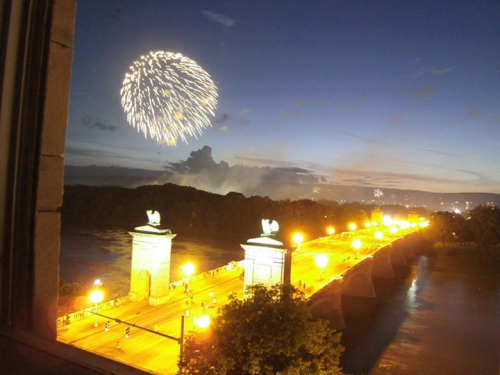
Ed Mountjoy, the face behind The Forgotten Place of NEPA on Facebook, had the extraordinary opportunity to watch the fireworks display at Kirby Park, from inside of the abandoned Hotel Sterling this year. (Way to go Ed!  You are my Urban Exploration hero!)  He explains:

“Seeing the fireworks from the Hotel Sterling that night was surely something I don’t ever expect to forget. Being up there, on the seventh floor, sitting there by that window, which was missing its bottom part of glass, was an odd feeling. It wasn’t odd in a bad way, but odd as in that I could actually picture people doing the very same thing back when the Sterling was occupied. The fact that it was dark all around, except for outside, added to the feeling, since the darkness covered up the fact about how gutted and decayed the building really was. While sitting on the floor watching the fireworks, I could just imagine someone in that very room doing the same thing decades ago. It was a historic view that many got to see in the past and, with this passing Fourth of July, it would be the last time anyone would get this view, from this very building, of the fireworks. Knowing this would be the very last year, I knew I had to get up there to see them.”

Ed Continues:

“This is WHY I maintain The Forgotten Places of NEPA and The Forgotten Coal Industry of NEPA on Facebook.  Places like the Sterling, won’t always be around.  Many, if not all, of the places I’ve been to have meaning to at least someone, whether it’s a small building on the side of a barely used road or structures that occupy spaces at the busiest of intersections. At some point, people worked and/or lived in these places, people I am sure have relatives that are alive today, relatives that may wanna see where their ancestors worked/lived at. I maintain these pages to keep those memories as alive as I can and I’m sure others seeing these photos trigger memories of either them working/living there, or knowing about family and/or friends who worked/lived there. Many might think that my pages are strictly just about urban exploring, but it’s not. Granted, most my photos involve having to do so, but I do it because I know many who’d like to see such photos can’t go there themselves. I do so, not just to explore the locations and get piles of photos, even though that is the best part of the experience, but to, hopefully, trigger some memories from others and maybe even learn a little more about these locations from those people.”

 SANYO DIGITAL CAMERA

Photo Credit: Ed Mountjoy

~*~

Return To Guerrilla History

TABLE OF CONTENTS


 Cheri Sundra © 2013
All Rights Reserved


Hotel Sterling: The UnDead Days

Abandoned Hotel Sterling: A Room With A View

 Zombie buildings are real.  It was a term first coined by financial analysts to explain the national collapse of the commercial real estate market as far back as 2006, and has expanded to represent all buildings that are unusable due to disrepair, because they are owned by entities that are too broke to fix them.

Based upon “Hotel Sterling: The UnDead Days”,  Welcome To The Zombie Hotel Sterling is now available for digital download at Amazon.com!  If you don’t have a Kindle device, don’t worry, you can download a free Kindle app for your smart phone or computer right here!

Book Description:

Abandoned and rotting away along the banks of the mighty Susquehanna River, the zombified Hotel Sterling tells its tale of fading grandeur and woe to a photographer visiting the deteriorating structure, seeking to photographically document the reality of the condition of the building, as the hotel waits for its beloved community to decide its fate, once and for all.

~*~

Read an interview about “Welcome to the Zombie Sterling” at: 570 Mine Fire

~*~

Back To

Guerrilla History

Table of Contents 

Cheri Sundra © 2013
All Rights Reserved

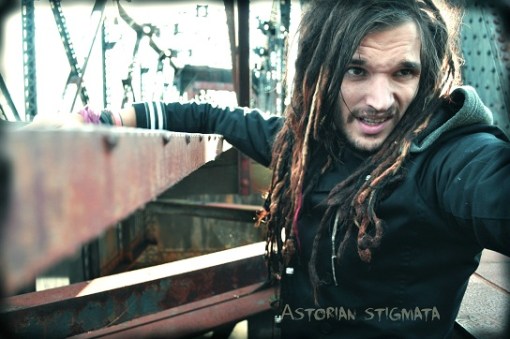
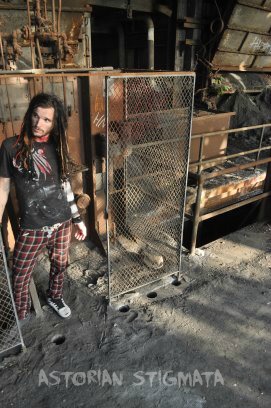
The Huber Breaker Rocks –with ASTORIAN STIGMATA

“Standing at the edge where beauty meets decay

Re-born through death

Time fades away and leaves a memory

But that red sky rests so quite

Upon the ashes of innocence

And some things never really come alive

Until after they have died.”

–“The Beginning Of An End”  (ASTORIAN STIGMATA)

Huber Breaker Ruins:  The Art of Industrial DecayThe Huber Breaker in Ashley,  Pennsylvania, USA

Sometimes, engaging in urban exploration is like experiencing an alternative reality.   In these abandoned and often beloved structures, ghost-like representations of what “once was” collide head-on with their current state of decay and ruination, representing a dream-like status between existence and non-existence, somewhere in the middle of life and death.  

Naturally, a local band with a name based upon the concept of an alternative reality, combined with the imagery of open wounds, and the catch phrase “Stay Dead”, would conclude that one of Northeastern Pennsylvania’s most popular urban exploration sites would be the perfect setting for filming a music video or two!  

As5

But according to Astorian Stigmata founder and front man, Dennis Condusta, his hometown, which is referred to as the “Victorian Corner of Pennsylvania” on the band’s Facebook page, always stars in his videos.  “I’ve traveled extensively and it has really helped me notice that Wilkes-Barre is a truly unique place in many ways”, Dennis explains, “Most of them aren’t positive ways, but in the architectural sense, it really has a “decayed elegance” feel.  Like it was once a prospering place during the coal mine era and now it’s kinda run down, and somewhat dismal.  I noticed over the years that the message in my music was very similar to that.  I’ve always been drawn to the concept of once beautiful things fading away.  I know that they always can return.   It’s kind of a positive way to look at decay and things falling apart. And “Victorian Corner” is just a reference to a lot of the Victorian era architecture in the surrounding area of Wilkes-Barre. I’ve always been drawn to its class, and most of our records have Victorian era houses on the cover.”

While discussing the Astorian Stigmata video “Ballroom Dancing, Condusta said that their European fans often make comments about how much they love the look of the old historical stuff here in Pennsylvania.  “Most of those shots (in the video) were right in the downtown area, the apartments across from the River Front, and close up shots of the Sterling Hotel”, he stated, “And the European fans say things like “I’d love to visit Wilkes-Barre!” Ha-ha. I think it has a lot to do with the way it’s represented”, he explained, “We really romanticized the place in all our work.  And people from here never realize how truly unique and beautiful a lot of the things we have around here are, mostly things left over from the coal era.  If we become a bigger band it’s going to be a good thing for Wilkes-Barre tourism!  Ha-ha.  It always kinda bugged me how bands move away from their home to embrace the music scene other places or whatever, and that’s all fine.  But I see myself as an artist far before a musician who is trying to “make it” or anything like that.  So I do my best to represent the area I am from because it has played such a huge part in my artistic understanding of the world around me.”

Abandoned Hotel Sterling: The Harsh Light of DayThe Hotel Sterling ruins in Wilkes-Barre, Pennsylvania, USA

Condusta came up with the band name in 2003 while watching an HBO show called “Carnival”–specifically,  an episode titled “The Road to Astoria”, when he became intrigued by the idea of an alternative reality, but one  very similar to the one we know. That “alternative reality” notion  is the main reason I chose to write about Astorian Stigmata for my blog about urban exploration, because that is the very concept that urban explorers are trying to capture when they photograph the abandoned structures where people once lived, worked, played, worshipped, dreamed or suffered. 

AS2

Condusta was drawn to the word Stigmata for its powerful look and strong pronunciation.  Which is a relevant choice, because the visual images portrayed in many of the band’s videos are both harsh and destructive.  Yet, in listening to the lyrics, you can’t miss the sentimental vibe—like a verbalized wish that life was less fragile and that people, places and things could be more permanent.  

Dennis explained that “most of my lyrics are about dualities.  Which is also why we use black and white stripes so consistently in our logo and branding—they represent the ups and downs of life, and that they are both equal, and both present at all times.”    Many of their song lyrics are quite philosophical, touching upon concepts such as being “re-born through death”, as in the lyrics of the one video filmed at the Huber Breaker.  “It refers to an existential death and coming back to life as a better person, but only after your old sense of self has died”, Dennis stated.  Fans consider the band’s catch phrase, “Stay Dead” and their entire “death” theme, as a metaphor for the kind of self-fulfillment that leads to happiness by remaining true to yourself.

In fact, staying true to themselves is even embraced by Astorian Stigmata in their business model, because they literally do everything themselves.  Dennis explains that being an “indie” band allows you to do things, your way, all the time, when you want. We’re pretty specific about what we are trying to say and do.”  According to Dennis, “I’ve always loved design/photography/hand printing t-shirts/video/editing/music recording/writing and production–even the hard work like hand making every CD. Our guitar player, DJ, is the same way. He  enjoys it all and we work well together as a team. We don’t call ourselves a “punk” band, but we carry that flag and ethic as hard as anyone.  Not because we want to, but because no one is gonna do anything for us.  We’ve been offered record deals and things, but we’re not dumb dudes in a band. We understand how business works, and how things happen, and that 90% of the industry side of music is there to fool you into making them money.”  

Condusta further explains that as an artist, his focus isn’t the same as that of a corporate business entity, only interested in creating mainstream conceptual “art” that is made popular for the purpose of selling it quickly, “We make lasting art. Songs we wrote 5 years ago have as much relevance now as they did then, and will still be relevant 20 years from now.”

AS1

Dennis Condusta became interested in playing guitar at a young age, because his older brother also played.  As luck would have it, he won a guitar when he was 16, at a BMX riding contest.  He was influenced by the music of Modest Mouse (“Dramamine”) and Taking Back Sunday (“A New American Classic”) plus a strong desire to create his own music.   “I have no interest in learning cover songs.  I just knew I had a feeling inside me and I wanted to learn to get it out as fast as possible”, he said.  Dennis also states that his most important influences are his brother and his friends. 

Condusta, a life-long resident of this region, known for its working-class sensibilities, which are often hallmarked by the suppression of individualism, did note that this area sometimes has a lack of respect for a broad variety artistic expression.   Still, he credits this area for helping him to form his artistic vision, and openly accepts the responsibility and challenges required to act as the ambassador of his own vision, “I do not see that as their fault for misunderstanding me, I see it as my own fault for not doing a good enough job at being understood.  I am not afraid to dress strange or to wear two different shoes, it reminds me not to take life too seriously. You’d probably be surprised at how little people notice/care about how crazy someone looks if you do it confidently.  It’s when you feel uncomfortable or out-of-place that people can sense it, then they insult you.”

As6

Much of our local history is dark and reflective of the oppression of the human spirit, because for a long period of our recent history, the area was monopolized by an industry that told people daily that they did not matter.  In fact, the mules that worked in the anthracite coal mines were insured, while the humans laboring there were not!  Local workers had to resign themselves to the fact that they were being exploited, just for the opportunity to earn a paycheck.  “That coal miner mentality is still engrained in the people from this area. I think it plays an enormous role in the art I create, so I respect it very much and choose to embrace it”, Dennis said, “There is a dark cloud of oppression that just sits over this valley, although it’s not strong enough to keep me down in any sense.  I find it comforting– in a totally sick and twisted kinda way. Ha-ha”

One of the prominent remnants of the coal mining era, the Huber Breaker ruins, has a starring role in two of Astorian Stigmata’s videos. (For those of you outside of Northeastern Pennsylvania, a coal breaker is literally a place where the coal that was brought up from the mines was broken into smaller pieces using machinery.) This location is popular with urban explorers because they love to photograph the machinery and vanishing points that are contained within the decaying walls of this now obsolete industrial complex.  I asked Dennis to explain the inspiration behind using this location for these videos.  “It’s one of a kind”, he said, “And it’s in rather good shape for how old it is.  That place has a feeling and a beauty to it I’ve never felt anywhere else.  It’s special in that sense and it’s really inspiring in many ways. It’s hard to explain.”

AS4

I asked Dennis if he thought that exposing non-history buffs or individuals unfamiliar with our local history, to our historic locations in a non-traditional artistic context is a good way to inspire an interest in the subject matter.  “Yes, I do”, he responded, “Our target audience has never been local.  We’ve always strived to appeal to a worldly audience.  Most local people think the Huber is played out, ‘cause they’ve seen it so many times, but there’s a person sitting in Norway right now watching that video thinking that’s the coolest place they’ve ever seen.”  

And believe me, he’s not kidding!  One of my personal, most interesting experiences with the Huber Breaker includes running into a group of students from Germany, taking pictures of the Breaker, as one of their stops on an “Urban Exploration” tour of the industrial ruins along the east coast of the United States!

I asked Condusta, a descendent of coal miners himself–both of his great grandfathers were employed by this industry–if he had any thoughts about using a place where men, and even little boys, were oppressed and exploited to express himself artistically.  He said, “Yes, I always think of that.  And sadly the world still works that way.  I always kinda wished people knew the background on the industry and of that place ‘cause it would add a whole new dimension to the message I’m trying to send.”  Although Dennis maintains that the videos and pictures are primarily for aesthetic purposes, and produced for a world-wide audience who does not see such places as they go about their daily lives.     “While I understand and respect the history personally”, Dennis explains, “I don’t expect someone in Spain to think of that.”

AS3

Of the two Astorian Stigmata videos filmed at the Huber Breaker, “The Beginning Of An End” is the most artistic in nature, and therefore open to individual interpretation.  I thought it would be interesting to analyze the video/lyrics within the context of the historical setting with Condusta. 

The start of this video features a guy in a camouflage suit collecting water samples from this industrial site in a post apocalyptic world.   I found it somewhat poetic that in the beginning of the video you hear “stay safe”, because the irony is that for the men who worked at that dangerous site, in such a high-risk industry, that’s what they, and their loved ones, were thinking every day.  Dennis found that interpretation interesting, but said that it wasn’t quite what he was thinking while creating that scene for the video.   The video also features a vampire, which I interpreted as a representation of the coal company literally feeding off of the coal miners to turn a profit for themselves, while their employees often lived in impoverished conditions.

The song lyrics contain the phrase “where beauty meets decay”.  I asked Condusta if he thought there was something tragically beautiful about this specific abandoned industrial site.  “Yes, most certainly”, he said, “It’s symbolic of what was once flourishing, busy and a source of life and jobs for an entire city. And now it’s pushed aside and forgotten. That’s the central theme of my artistic being.”

I asked Dennis why he chose to end the video with the sound of a laughing child.  “That was just to provide and exaggerate the feeling of unease that I was attempting to convey”, he explained.

The video “Strange Nights (Live From The End Of The World), was also filmed on location at the Huber Breaker.  I asked Condusta if there was something about the location that promoted an “end of the world” feeling.  “Yes”, he responded, “It reminds me of what the world would look, and feel like if it were to suddenly end. I found a worker’s time card in the breaker dated from 1962.  It’s just interesting to think about how so much of that place seems like the workers just walked out at the end of the shift, and didn’t come back. It doesn’t feel like it ever planned to close–it has a feeling of unrest.”

In conclusion, I asked Dennis if there was anything that he wanted people to know about himself or Astorian Stigmata.  “Myself personally?  I’m not a terribly interesting person”, was his response, “I put my life into art and I ask for nothing in return. I don’t do this for money/fame or reputation. I was just born with a soul that needs to express itself, and I hope somewhere along the way someone else gets some enjoyment from the work I do.”

You can find more information about Astorian Stigmata by visiting their official website  and  Facebook page .   

Max 3

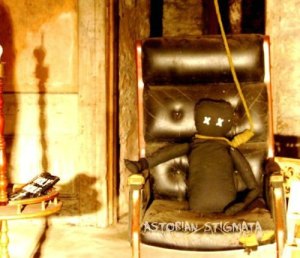
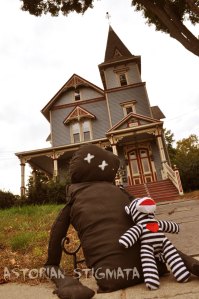
Maximilian Aladar was born on May 28th 2005.  He is the creation of Dennis Condusta who was in need of someone to play the drums for his band, because at that time, he was playing all of the instruments himself on the recordings.  Dennis made Max that very night, never finishing his legs or giving him a mouth.  This way, Max could not talk back (using words) or run away.  Today, Max serves as the guide for Astorian Stigmata.  He is the puppet master who is a puppet…..

Max 1


Back To

GUERRILLA HISTORY

Table of Contents

Cheri Sundra © 2012
All Rights Reserved

Into the Belly of the Beast: Exploring The Mines That Fed The Industrial Revolution

Disclaimer:

I feel the need to have one of those “Beavis and Butt-head are not role models. They’re not even human, they’re cartoons.  Some of the things they do could cause a person to get hurt, expelled, arrested… possibly deported.  To put it another way, don’t try this at home” warnings at the beginning of this post.  

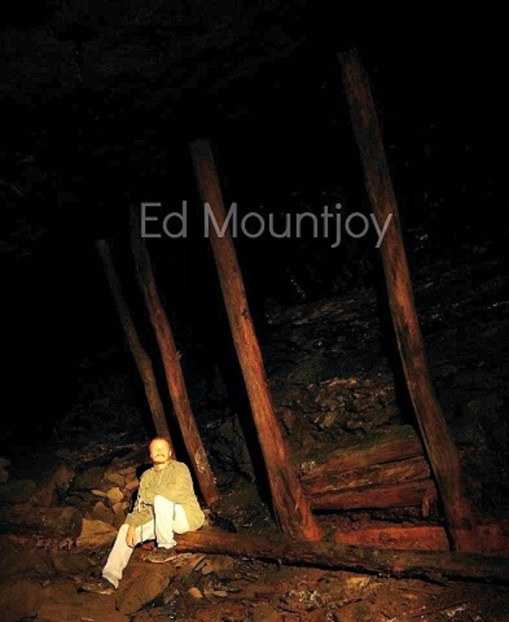
While Ed Mountjoy is NOT a cartoon character (although some may disagree), what he does is EXTREMELY DANGEROUS, and you should just resign yourself to enjoying his adventures from the safety of your computer/smartphone screen.  But since urban explorers tend to view “No Trespassing” signs as invitations to enter, I won’t bother coming up with a disclaimer of my own….I’ll just stand by what Mike Judge said, just insert Ed Mountjoy and abandoned anthracite mines for yourselves!  😉 

Ed First

Many Social Media users in Northeastern Pennsylvania (NEPA) recognize Ed Mountjoy as the face of The Forgotten Coal Industry of NEPA’S Facebook page.  But Ed’s following is quickly spreading beyond the “coal region” of Pennsylvania, and into the realm of the world-wide network of urban exploration.  And understandably so, since within the “explorer” hierarchy, those who explore the territory below the earth’s surface definitely carry more prestige than those of us who remain steadfastly with our feet planted above the ground. 

Ed 2

While there are coal deposits scattered about the world, the coal from Northeastern Pennsylvania  is special  because it is anthracite coal, which is more pure, harder, and of higher carbon content than any  other type of coal on the entire planet.  In the Western Hemisphere, 95 percent of the anthracite coal supply is located within the 500 square mile region of Pennsylvania that is the topic of Ed’s “Forgotten Coal Industry” Facebook page. 

The story of anthracite coal mining in NEPA is complex.  It’s about pioneering industry and the entrepreneurial spirit, as well as the darker side of greed, suffering, and human exploitation. During the coal era in NEPA, the elite Coal Barons (coal company owners, a.k.a. The 1%) built magnificent Victorian mansions, as their immigrant workers often lived in overcrowded, company-owned “patch towns”, while actually having to pay their employer for the supplies necessary to do their high-risk  jobs that resulted in earning less than what we would call a “living wage” today.

 The coal mines of Luzerne County have been abandoned for decades now, but Ed Mountjoy is on a mission to document and share whatever remains he can find that relate to our local coal mining history before these remnants are gone forever—especially those places or structures that are hidden away from us as we go about our daily modern lives full of urban sprawl. 

While many urban explorers have documented popular local coal-related locations such as the Huber Breaker and Concrete City, Ed ventures into an area of local exploration that you never really hear about—the actual anthracite mines themselves.  Since exploration is ultimately about documenting the remains and ruins of the places that touched the lives of the people who once lived, worked, worshiped, or played at these locations, Ed is honoring the men who worked in these coal mines by reminding us all about the physical reality of their confined work-space. 

A Slope Leading To A Flooded Mine

A Slope Leading To A Flooded Mine

One truth remains the same today as it did for the men who toiled daily underground decades ago in NEPA–anyone entering a coal mine faces many dangers such as underground floods, roof falls, a mine collapse, fire, and countless other methods of serious injury or death.  A coal mine is not a glamorous place to be at all. The men working underground found themselves in an environment that was dirty, dangerous and most likely damp.  Standing up straight is almost impossible because mine tunnel ceilings are too low.  The air that you breathe in a coal mine is stale & dusty.  The miners actually had to use pieces of lumber to prop up the roof in the area that they were working in, as an attempt to avoid being trapped or crushed by huge rocks.  This knowledge gives anthracite mine explorers an adrenaline rush when something seems out of the ordinary during a mission.

“During a recent exploration, we thought we were hearing part of the mine collapsing, but it turned out to be some rocks sliding down an incline we just went up. That scared us but we were relieved to know it wasn’t the mine collapsing”, explained Ed.

Ed began seriously exploring abandoned anthracite mines at the end of 2010.  He had explored the remains of two collieries (for those of you outside of the NEPA region, a colliery is a coal mine and the buildings associated with it) as well as other abandoned buildings as far back as 2006, so he was already interested in abandonments.   “ I was informed about two mines and originally was just going to find them and get exterior photos of the openings into them”,  he explained, “ After several attempts looking for them, we, a friend and I, found them and saw they were low mine openings, meaning you have to crawl to get inside. We decided to enter them and the interest just sparked from there after seeing what we had inside of those two low mines.”

When asked how he finds mines to explore, Ed responded, “Well, I normally do research about what mines were in opperation around a particular area before exploring.  Sometimes, we’ll just run across a mine and, after exploring, will do research afterwards on what mines they may have been and what companies owned them during their years of operation. As for preparing to explore one of these mines, we’ll examine the conditions of the opening before entering; making sure the ceiling isn’t in horrible condition.”

Props Holding Up Mine Ceiling

Props Holding Up Mine Ceiling

As far as equipment goes, Ed approaches mine exploration on the lighter side by just carrying a flashlight, camera, tripod, and a drink.  He is also sure to take someone else with him. “I NEVER explore any place alone”, he stated, “I always have at least one other willing friend who comes with me. You never know what can happen when exploring any abandoned place, and mines are no exception.”

I wanted to know if he ever got lost while engaging in his underground exploration adventures.   Ed’s response was that he has never been lost, not even while exploring the largest mining system that he has been in, “I have a rather good sense of direction and can retrace my steps back, plus some of the mines still have arrows painted on the walls and ceilings pointing to the exit from back when they were mined”.  

I was curious to know what Ed considered to be the most difficult aspect of this type of exploration.  “Finding any mines that haven’t been sealed closed, and seeing if they are safe enough to enter, if they are still open.  Most of the mines that were in operation have been sealed off, whether they were blasted shut, filled or grated off.   Even many of the ones that were left open, either due to being forgotten about or just haven’t been attended to yet, have since collapsed on their own”, was his response.  He further added, “It’s more dangerous than an above ground structure. The deeper you go, there is more of a chance that something can happen and less of a chance you’ll be found, unlike a building where if you get hurt, chances are you can get a cell signal and call for help. Mines and other underground places tend to have no cell service, so it’s best to tell another the location of where you’re going, in case something does happen”.

A Steep Pitch Mine

A Steep Pitch Mine

While describing what it is like to spend time in these abandoned underground work spaces today, Ed thoughtfully explained that it’s quite peaceful, “Its dead quiet in the old mines. The most you may hear, besides yourself and whoever is with you, may be a few bats, which I have seen hanging from the ceilings, and water dripping from the cracks in the ceiling. The quietness adds to the thought of knowing that at one point, there were men down there digging those tunnels, setting up those props and loading coal into the mine carts to go to the surface to be processed at the breaker, which, during those times, the mines would have been anything but quiet.”

I asked Ed what he was hoping to accomplish by exploring these abandoned anthracite mines.  “To show others an aspect of our history that is overlooked today. Most know about the coal mining history, and others may have explored some of the places that are still standing, such as the Huber Colliery, but not many get to see the very mines where the coal was brought out of to be processed at these breakers.  My photos are a way to document and preserve the history of a once prosperous industry”, was his response.

What really leaves an impression on Ed about these underground spaces where men had to work every day is “how low some of these mines were, and knowing that there were men who actually dug those low mine tunnels out to get to that coal. Just try to imagine crawling around in a tunnel no more than four feet tall trying to dig further into it, trying to reach as much of the coal as you can without the solid rock above you crashing down on top of you. That’s what it must have been like for those miners.  What would probably surprise most people is how low some of these mines are and the fact that men were actually down there, crawling around, grabbing the coal from those low mines to earn a paycheck.”

A Prop Holding Up A Low Mine

A Prop Holding Up A Low Mine

You can follow Ed Mountjoy and all of his coal mining exploration endeavors on Facebook at The Forgotten Coal Industry of NEPA

Ed 11 

 “Because it’s their time. Their time!  Up there!

Down here, it’s our time. It’s our time down here!”

–The Goonies

I encourage anyone interested in learning more about

abandoned mine underground research to visit :

The Official Website of Abandoned Mine Research, Inc.

and please note this warning about abandoned mine exploration:

Stay Out….Stay Alive!

~*~*~*~*~*~*~*~*~*~*~*~*~*~*~*~*~*~*~*~*~*~*~*~*~*~*~*

Return To

GUERRILLA HISTORY Table of Contents

Cheri Sundra © 2012
All Rights Reserved

And They All Came Tumbling Down

The event that I am most often asked about is the collapse of a pavilion at the (now abandoned) Croop’s Glen Amusement Park —during a baby contest, of all things! 

In April of 1917, a newspaper blurb announced that “A new picnic ground with every known amusement device is being built at Hunlock’s Creek and will be open on May 28th as Croop’s Glen”.  By the 1930s, the park became a very popular venue for civic group outings which were often publicized in the local newspaper. 

Between 1926 and 1927, two wooden roller coasters were added.

There was a full size coaster named Twister, and one Kiddie Coaster.

Both pictures  of “Twister” courtesy of the Philadelphia Toboggan Company

Roller Coaster Entrance

Photo Courtesy of Ellen Geisel

During an outing planned by the Nanticoke Unemployed League in June of 1935, as mothers were assembling on the pavilion with their children for a baby show along with observers, the floor of the pavilion, which was situated between 20 & 30 feet above the bed of Hunlock’s Creek, parted in the middle and then dropped.  A witness account described a “roar of furniture, crockery, glass and human bodies falling into the creek”.   

Croop's BAbandoned Park Picnic Tables in 2010

According to the newspaper ““The floor of the Pavilion broke in two, creating a large funnel into which tumbled men, women and screaming children, together with benches, chairs and tables and the paraphernalia   usually taken along by picnickers”.   Witnesses estimated that between 250 and 300 people were standing on the pavilion at the time of the accident. 

Dance Pavilion?  Could be…..

Photo Courtesy of Ellen Geisel

Fortunately, the sides and roof of the structure stayed intact, contributing to the fact that no one died during or after the catastrophe.   As a result of the collapse, 145 people were admitted to the hospital.  A local newspaper reported that “after the rescue work, shoes, purses, hats and bits of clothing could be seen in the wreckage, mute testimony of the horror that overtook the hundreds who were on the pavilion.”

The park was owned by B.F. Croop and the land was leased to Charles Shelly who was the park manager.  According to the newspaper, officials of the Nanticoke Unemployed League Council initially expressed belief that over-crowding caused the accident.  Complete details about the accident are available thru the Luzerne County Library System’s Sunday Independent online archives at “200 Picnickers Injured Here As Dance Pavilion Collapses”.

On July 10th, 1938, the newspaper reported that the park was being sued by 12 people for injuries sustained during the pavilion accident.  The majority were seeking $5,000 in damages, a few asked for $10,000 and the highest amounted to $15,000.  Visit “$96,000 Damages Asked by 12 for Injuries In Pavilion Crash” to see a list of the plaintiffs. 

While many people speculate that the accident and subsequent lawsuit led to the closing and abandonment of Croop’s Glen Amusement Park that does not seem to be the case.  An article from August of 1943 states:

 “Noted for years as one of the regions natural parks, Croop’s Glen this year is a complete casualty of the war effort.”

Carousel – photo by Croop’s Glen Art Studio

Photo Courtesy of Ellen Geisel

”The park has been renovated substantially since the dance hall collapse ten years ago, but the rollercoaster, whip, dodgem, merry-go-round and kiddies train, to mention the leading amusements have not turned a wheel this summer.”

Carousel

Photo Courtesy of Ellen Geisel

“They, as well as the penny arcade, refreshment and prize stands, are covered as protection from the elements.  The swimming pool, which for many years was one of the best patronized in the region, because of its mountain-fresh, ever-flowing water, has also gone to pot.”

Croop's D

Swimming Pool Remains in 2010

“It was a favorite place for basket outings and still has excellent facilities, including a large outdoor oven and scores of tables and benches if people were so inclined.”

Croop's c

Concession Stand/Picnic Grove in 2010

The article also mentions that lack of public transportation was contributing to the decline of the park.  You can access the full text of the article at “Park At Croop’s Glen Complete War Casualty” 

I was unable to find anything stating when the park officially closed, by some accounts; it remained open as a picnic spot through the mid-50s, with the dance hall serving as a skating rink. 

Croop's AAbandoned Park Picnic Grove Structure in 2010

More Croop’s Glen Updates Here

~*~*~*~*~*~*~*~*~*~*~*~*~

Return To

GUERRILLA HISTORY Table of Contents

facebook

Abandoned Pennsylvania--Lost History Found:  Croop’s Glen Amusement Park, Hunlock Creek   Cheri Sundra © 2012 All Rights Reserved


A Monkey in the Colliery, The Bear From Vaudeville & Politics of An Eagle: The Rise and Fall of the Kirby Park Zoo

What do we really know about the Kirby Park Zoo? 

 The Kirby Park Zoo, once located in Kirby Park somewhere along the river, completely vanished into history during the World War II era.  Still, the zoo is one of Wilkes-Barre’s legends.  And rightly so, it is captivating to imagine a simpler time when communities nationwide not only had amusement parks right in their own back yards, but municipal zoos were also popular local attractions.  And the Kirby Park Zoo was popular!  It had somewhere between 2,000 to 3,000 visitors during the weekends in the summer months, according to newspaper coverage from the days when the zoo was in operation.
Third Structure (6)

“Zoo” Grafitti

I don’t quite understand why, but there is a tendency for locals to “spin” these regional venues in such a way that they become shrouded in controversy and mystery over time.  It must be a function of the human mind to weave our childhood fantasies into our memories about events and locations. 

When I was doing research about the Kirby Park Zoo, on more than one occasion, people told me that their deceased relatives told them stories about the elephants of the Kirby Park Zoo.  Which is just bizarre, there is no way that the city of Wilkes-Barre housed elephants right next to the Susquehanna River!   I wrote these instances off as just a miscommunication created as a result of being a generation or two removed from actual historical events.

Abandoned Nay Aug Park Zoo 1 HD

Abandoned Giraffe Sculpture at Nay Aug Park Zoo


But I recently became aware of the fact that this phenomenon also happens within the generation of people with first-hand experience, while photographing the remains of the now defunct Nay Aug Park Zoo in Scranton.  A couple stopped by the remaining zoo cages with their adult children, and proceeded to tell them about their “memories” of the giraffes that lived right there–in the elephant house!  Apparently, when you DO have elephants in your local zoo, people remember giraffes instead!    

An Abandoned Zoo Christmas:  the remains of the Elephant House, Nay Aug Park Zoo, Scranton Pennsylvania

Nay Aug Park Elephant House At Christmas

The mystery surrounding the Kirby Park Zoo is magnified by the fact that the location itself was cut off from Kirby Park more than 70 years ago when the levee was constructed to protect the area from flooding.    While the park on one side of the levee remained a neatly manicured public area, the other side became overgrown and even served as an illegal dumping ground for unwanted debris for several decades.   During the 1990s, preservationists started clearing the long-forgotten area between the levee and the Susquehanna River, uncovering a handful of lost ruins. That’s when the urban legends about the long forgotten Kirby Park Zoo began to grow as more people began to frequent the area while walking or fishing along the Olmsted Trail and would come across these structures. 

Third Structure (4) Side
Kirby Park Zoo “Ruins”

Through research, I’ve learned that the Kirby Park Zoo was mentioned in the original Olmsted Brother’s plans for Kirby Park, but as far as I can tell (please, someone prove me wrong!), the world renowned firm did not design plans for the Kirby Park Zoo per say, although the Olmsted’s did (obviously) design the Olmsted Trail where the zoo most likely would have been located.
Olmsted Sign
We know the zoo was definitely in place by 1932, because Wilkes-Barre architect Clark Wright Evans (architect of the Westmoreland Club) designed an improved  “zoological building” for Kirby Park in that same year. His plans were advertised for bid in the November, 9 1932, edition of the Philadelphia Real Estate Record and Builders Guide. The index for those plans says that the building was “destroyed by flooding in 1936”, but local newspaper articles about the zoo make it impossible to believe that it was ever built in the first place!  (Hmmm….Typical “Luzerne County Style” politics at work even back then? –-Of course we lost our un-built zoo building in the flood, can we get some federal compensation for it?!) 

Based on contemporary newspaper descriptions of the zoo, it’s hard to conclude that any of the “ruins” in today’s Kirby Park Natural Area were ever used to house zoo animals, which was a popular belief perpetrated by local news coverage.  (You can read all about my research concerning the remaining structures here.)  Because of all of the mystery, some people have suggested to me that maybe the zoo never existed at all!   On the contrary, our local newspaper coverage shows that not only did the zoo exist; the community loved these animals so much that they were personified and their actions were often part of local news coverage.  The zoo also became embroiled in controversy as community members became more aware of the potential for unintended animal cruelty because of the limitations experienced when cultivating a small community zoo, much in the same manner as other comparable zoos nationwide, like Nay Aug Park.

While the Kirby Park Zoo did not have a happy ending, which is most likely the main reason its history has been “lost” and its actual location forgotten, I still think that it is an important part of our local history, indicating a lot about the character of our community.  The story speaks of values and politics, and tells us about what we were like as a culture during that snapshot in time through our relationship with animals.  And for that reason alone, the rise and fall of the Kirby Park Zoo is a tale that needs to be told!

News Coverage: Kirby Park Zoo Animals From Start to Finish

(As if sorting out the information about this vanished landmark isn’t difficult enough, a 1994 article in the Times Leader says that the zoo opened in 1932, “with great fanfare” (“Monkeys Made Kirby Park Swinging Place”, July 13, 1994).  BUT, as you can see, news accounts about the zoo predate the “opening date”.  AND the architect mentioned above was just advertising his zoo plans for bid in November of 1932. )

April 10, 1926

“Bear Given to City—Gift Will Mark Start of Zoo in Kirby Park Maurer Announces”~~Wilkes-Barre Record

“An eight month old black bear was presented to the city yesterday.  The bear was turned over to Councilman Maurer, commissioner of parks, who had it sent to Kirby Park, where according to Councilman Maurer it is the intention to establish a zoo in keeping with the wishes of F. M. Kirby, donor of the park. 

“The bear romped around in the windows of Decker-MacLean store for several weeks prior to the fire.  But at the time of the conflagration, it was in a garage below South Main Street.” (I don’t know what that means…..but it sounds awfully suspicious!)

“According to Councilman Maurer the bear is as tame as a kitten and was the playmate of children while in the store.” (Yikes!)

“Yesterday afternoon the bear was taken to Kirby Park in a street department truck and placed in a temporary home in the rear of the residence of Thomas Phillips, supervisor of parks. (Who was this bear?  Winnie-the Pooh?!  Why are they playing with this bear and taking the bear home with them?)  It is the plan to erect a wire fence in the wooded section of Kirby Park south of the residence overlooking the river and which was erected by Thomas Podmore (Caretaker Cottage).  A dug-out is to be built for the bear and the environment will be made as natural for him as possible.”

Kirby Park old post card of cottageCaretaker Cottage then

Caretaker cottage TODAY 1Caretaker Cottage Ruins Today

July 29, 1930

“Monkey Percher Back in Zoo, Thanks to Cat”~~Wilkes-Barre Record

“It’s not a case of “and the cat came back”, not this time.  It’s the monkey, for the gay young female of Kirby Park Zoo was returned to her habitat yesterday after a week’s perching in and about various trees in Nesbitt and Kirby Parks.  However, it was a cat that was responsible for her return.” 

“Miss Simian, or whatever her name is, after tiring of her tree perching and wandering about aimlessly in the park, decided that being in the Anthracite region she should explore a colliery.”

The article goes on to describe how the monkey was cornered by the cat owned by the watchman at the Glen Alden Coal Company and returned to her cage at the Kirby Park Zoo.

October 18, 1930

Wilkes-Barre Record

It is mentioned that an opossum that was captured by a PP&L employee and presented to Councilman John Noble to place in the Kirby Park Zoo.  (Also interesting to note: a second one was brought to him on October 21!)

March 19, 1936

“Bears Moan As They Cling To The Top of Their Park Cages” (During the flood of 1936)~~Wilkes-Barre Record

Kirby Park Zoo Bears 1936 Flood

“Human life comes first, but the plight of the three black bears left in their high wire cage in Kirby Park when the river rose for a second time within a week, yesterday afternoon touched hearts of officials and others who had the right to be on the western end of Market Street Bridge.”

“As the waters rose, the bears climbed onto the top of their curved roof home.  They had been forced from other high spots in their cage during Thursday night and were compelled to seek refuge on the roof.”

“Although efforts are said to have been made to reach the animals, they were not removed.  As the river steadily rose, the three moved around precariously on their small roof and at dusk appeared to have about three or four feet before the water would hit the apex of the curved roof, which is about six feet long.”

“Pitiful moans rent the air during the afternoon as motorboats and row boats took refugees from their homes to the western approach of the new bridge to be transported to central city ambulances.”

“The deep toned cries, and occasional high pitched screech, cast a weird spell over those who were on the western edge of the bridge and although within seeing distance, were separated from the bear den by a stretch of water several hundred feet wide and as deep as 10 feet, according to what could be seen of the light standards in the section of the park.”

“It sends shivers up and down my back every time I hear the poor things cry or moan”, said Chief County Detective Richard Powell.  It’s too bad they were not removed.  They are like humans and they sense and see the danger and they are panicky.” 

“The bears appear to be hanging for dear life by their claws.  Every once in a while two of the animals would rub their necks and noses together as if one was attempting to console the other.  One, said to be the oldest, and said to be suffering from rheumatism spent most of his time on one side of the curves roof away from the other two.”

“Dr. Emory Lutes, city veterinarian, was asked last night about the plight of the bears.  He said the animals were on the roof of their home and that if the water reached the apex of the structure, most of the city of Wilkes-Barre would be under water.”  

 March 28, 1936

“Flood Damage Vast in Park” ~~Wilkes-Barre Record

“Pictures of Kirby Park after the flood were obtained by council yesterday and reveal an enormous damage.” 

March 29, 1936

“Zoo at Kirby Park Regains Occupants”~~Sunday Independent

 “Tranquility once again prevails at Kirby Park zoo.  Turmoil, provoked by high water of the Susquehanna, routed all animals, the rescue work being carried out by city employees under direction of Park Supervisor Tom Phillips.  Last night the “refugees” were back home. Only one casualty, the male buffalo, was listed. Poisoned food hastened the end of the quadruped, according to Councilman John Nobel. A female buffalo, all fox, rabbits, groundhog, honey bears, monkeys and the eagle were quartered in the 109th armory during the flood.  Three bears, cynosure of all juveniles visiting Kirby Park, withstood ravages of the disaster. The water came up so rapidly they could not be rescued and were forced to perch atop a stone house inside a cage. The animals were foodless for five days and did virtually no sleeping during the flood period. Over four feet of water swept through the bears’ habitat.  Alas and alack – Pete, the pet gose [sic], joined his colleagues yesterday. Pete laughed at “Old Man River” when it began to swell. The winged pet watched the water flow over the west shore and continued to smile. On the third day Pete was hungry. He emulated Johnny Weismuller and swam all the way to Edwardsville, where he was picked up by two youths. The boys, fearful of prosecution, returned Pete yesterday to the park and they were told arrests would not follow.  So all again is peaceful with the speechless population of Kirby Park.” 

May 12, 1936

“Shoes Needed For Kirby Park”~~Wilkes-Barre Record

“Barefooted children will be barred from Kirby Park because of the presence of small pieces of glass and nails.”

“With the announcement by Councilman Houser yesterday that Alex the Bear , of Harvey’s Lake and Noxen fame, had been lent to the city zoo it was reported that some deer were forthcoming from the state.”   

May 12, 1936

“Alex Takes More Than Fall Out of Wrestling Mate, So He’s in Cooler”~~Wilkes-Barre Record

“Alex, the bear is behind bars—at Kirby Park Zoo—all because of a bad attack of stage fright. Emery Newell of Noxen, enterprising butcher, won Alex in a contest in January, wooed him with tidbits and tenderness and trained him to wrestle with some of his Noxen neighbors.”

The article goes on to explain how Emery took Alex to “some kind of carnival” in Phoenixville with his neighbor and Alex’s wrestling partner, Sam Dymond, also of Noxen.  Alex became too aggressive during the “performance” and injured Sam.  During the return trip Emery decides to drop Alex off at the Kirby Park Zoo to “cool off” while he hangs out with the other bears for the rest of the summer. 

The article continues to describe the more past dangerous exploits experienced by the entire Newell Family as well as another neighbor because Emery insists upon keeping Alex around as a vaudeville money-maker.  Emery tells the Kirby Park Zoo foreman William Law that he will return to pick up Alex for his next vaudeville tour.

 August 7, 1936

“Kirby Park Eagle Freed—Bird Liberated Near Wyalusing Where Others of Its Kind Are Seen”~~Wilkes-Barre Record

 “Wilkes-Barre’s eagle over whose head a lusty debate once raged has been liberated.” 

“It was finally decided that perhaps Dr. H. M. Beck, local dentist and sportsman, has been right all along, and the eagle did not have enough room in its gilded cage.  Dr. Beck and others have held that it was verging on criminal to coop up a bird like an eagle when it should be soaring over mountaintops and ledges.”

“So the decision was reached this week, following a renewed protest by the dentist to liberate the bird.   Councilman Houser, who inherited the eagle together with a lot of goats, buffaloes, bears, etc., in Kirby Park as commissioner, was not adverse to letting the eagle go as much as he said he would like to have the youngsters see it in the park.”


November 17, 1936

“Park Eagle Pete is Dead and Stuffed , Nobel Says—Former Park Commissioner Says He is Prepared to Show Liberation of Bird Was Mistake”~~Wilkes-Barre Record

“Is old Pete, the caged eagle in the Kirby Park Zoo for five years dead or alive?  Councilman John Nobel, former park commissioner and strong advocate of keeping the eagle in the zoo for the growing generation to see, says the American liberty token has been dead since five days after he was freed on Wyalusing Mountain, last June.”

Now, as if you don’t already think this story is weird, it’s about to get a lot weirder! 

“Dead by the hand of a relative of Mr. Nobel, a coincidence not discovered until last week when the councilman visited near Towanda and was informed an eagle had been shot.  He was told the bird was mounted and on display in the window of a Towanda main street merchant.  Recognizing it at once, Nobel said yesterday he will bring the bird to this city and display him in a Public Square window for all to see.”

“Let him bring it, say the advocates of the bird’s liberation.  They held that the bird’s cage was so located in the zoo that it was not possible to watch it, and the boys threw stones and poked sticks at it and teased it and annoyed it continually.  The Humane Society, Dr H S Beck and others pleaded for its freedom.  But Nobel, as park commissioner was adamant.” 

“Then election came along last year and Mr. Nobel was replaced by William B. Houser as park commissioner.  Houser promised that the bird would be freed and so it was in June.”

“Later, stories from St. Stephen’s Boys Camp at Vosburg related how the eagle had been seen on ‘them thar’ mountains.  The story even got out that Pete had mated and started to prorogate the species.  Whether this is true or not has not been thoroughly proven.  If Mr. Nobel is right, than the other story cannot be right.”

“However, Mr. Nobel’s threat to bring the eagle back for the citizens to see as a really dead one brought forth hope that he would do so by the Humane Society officers last night.  Nobel says the eagle’s beak is marked from the bars.  The others say it was not.  It’s marked in other ways though and that will be the proof, they say.  William Law, park foreman, who fed the bird for five years is considered the mainspring in the debate, for if he cannot identify the bird, no one can.”

 March 28, 1937

Sunday Independent

Page A-13

“There are seven monkeys, one baboon, two parrots, three macaws from South America, two raccoons, three foxes, about two dozen pigeons, three horned owls, four sheep, five bear, two wild goats from South America, one North American goat, one buffalo and two geese.”

In the same article, Ernest Vivian, the zookeeper, noted that the Kirby Park zoo could not accommodate additional animals:

“’If we had a larger and more substantial set of buildings than we have now, we could handle more of the gifts people are continually offering us but right now it’s impossible to take care of them.’ What were some of the animals offered as gifts? ‘Well, for example, pheasants and peacocks. We had to turn them down. We hadn’t any room and nothing could be done right now.’

‘The snakes and alligators the zoo had were given up. The snakes dug out of their pit one day and there wasn’t any way of keeping them safe unless we had a concrete base and a glass cage. But we have a lot of other animals here and the children and their parents will find that in a few weeks, when we open up, the collection will be as fine if not better than ever.”’

The article went on to note that:

“When summer is in full swing, between 2,000 and 3,000 people visit on Sunday and about the same number come in during the six week days.

Wilkes-Barre has a fine zoo for the amount of money expended on it. However, if the straitened financial conditions of the city ever are arranged so that a permanent structure can be built, the improvement would improve the zoo many fold.”

 April 14, 1940

Sunday Independent

Page A-4  

“Announcement that the Kirby Park zoo probably will be reduced to a monkey house – and nothing more – shows the change of the years. It’s not so long ago that most ambitious plans were in the air for the Kirby Park zoo. The park department still has some pretty pictures of the plans that were made. It was hoped to have a splendid building, big runways and everything to permit the animals to live as nearly as they do in natural surroundings. There were hopes of expansion so that a great variety of animals would be on display, for the amusement and education of the entire valley. That is a far cry from latest plans to have a monkey house – and nothing more. And it’s all a matter of money. In the old days the trust fund provided by Fred M. Kirby for the upkeep of the park brought in from $25,000 to $28,000 every year . . . Then came the depression. Now the amount the fund gives the city – after a couple of years of nothing at all – is about half what it used to be . . . Blame the depression.”

How NOT To Take Notes!

**I didn’t write down the date for this, but given the chain of events, it seems to go here…

 “Alex and Bear Pal, Sold for $25, May Be Turned Loose in Mountain—Houser Says City Will Be Rid of Costly Zoo Animals”

“Purchaser of Alex and his pal in the big cage that is to be turned into a monkey house, Dr Emory Lutes presented the check to the Park Department head yesterday.” 

The article goes on to say that Dr. Lutes along with the president of the Humane Society would announce the final decision about the bears at a meeting, but in all probability, they would be released back into the wild. 

“Councilman Houser was well pleased with the deal, particularly at the prospect of getting rid of Alex.  “He was a mighty bad boy when we had him in Kirby Park and last year killed another bear in the cage”, Houser explained. “The flood caused us so much trouble and expense and brought so many rats that we all decided to eliminate all the animals at the zoo except monkeys.  We plan to build a good house for the eight to 10 monkeys remaining and will use the bear cage this summer so the youngsters who visit the park can enjoy them.”

“Three other bears were in the cage at Kirby Park in recent years but all died or were killed.   The city’s decision to eliminate the zoo meets with the approval of the Humane Society.  Dr. Lutes recalled that at least 10 deer and several buffalo have died in their cages in recent years and the goats and a fox drowned.  Since rats infested the cages, the Human Association officials said the decision to tear down the wooden structures is wise.”

Deer Cage at Kirby Park Zoo

 May 5, 1940

“Filth at Kirby Park Zoo Forced Humane Society to Act”~~Sunday Independent

“The Kirby Park Zoo, for which the city of Wilkes-Barre spent thousands of dollars to establish and many more thousands to maintain, has turned out to be a filth-infested, highly unsanitary “haven” for wild birds and animals. Because health conditions are deplorable, reaching the point where the majority of the animal populace has either died or been killed off, the zoo now must be abandoned.”

“Survey of the situation yesterday revealed the fact that there are but two bears, one silver fox and a horned owl, outside of a flock of monkeys, remaining in the penned areas. The Luzerne County Humane Society has interested itself in the situation, as a step in clearing up matters, paid $25 to take over everything but the monkeys. The city will maintain cages for these.”

“In addition to filth brought by high river water, and given only western exposure and wooden houses when eastern exposure and concrete shelters are needed, it is reported thousands of rats have infested the pens at Kirby Park to aggravate a bad situation. These rats made life miserable for other animals by stealing food and, it is believed, spread disease among the inmates.”

In addition to the drowning of a silver fox and two goats in the recent flood, three bears recently “murdered” each other and killed a cub, the two buffalo and a calf have passed away, while none of the ten deer survived. It is believed the zoo was improperly located from the start, situated in soggy ground, and another matter that enters into the picture is the fact that feeding and care of the animals in recent years was but a sideline of caretakers at the West Side Park.”

The coverage concluded by describing how the Humane Society planned to release the two bears into the woods of Noxen Mountain.”

May 12, 1940

Sunday Independent

“To all intents and purposes the Kirby Park Zoo – the Wilkes-Barre City Zoo – has gone and the fact that it had to go, plus the manner of its passing, is not exactly a boost for the town.”

“The zoo was situated in a park, the upkeep of which along with that of the animals was provided for by the philanthropy of Fred M. Kirby.”

“Naturally, the income from the bonds Mr. Kirby provided has shrunk, but hardly is it likely that it has shrunk as much as the park of which the city once was so proud.”

“Conceived as a place of beauty for the city, the main expanse of the park has been taken over to a great extent by the dike leaving, with the zoo gone, several baseball fields on the flat stretch next to the armory and, nearby, the tennis courts.”

“Worst of all, however, was the action of the Humane Society in “buying” the animals. This, they said, they felt was necessary in order to live up to the creed of their organization. They did not consider the animals were being treated in a humane manner at the zoo.”

“Life will go on in Wyoming Valley, of course, as it did before. Many other little niceties also could go and some people seem intent on removing them too, getting the general population down to the elementary necessities of eating, drinking, sleeping and working. (Interesting statement!)

But the zoo was enjoyed by many – including the children. It added just a bit to their pleasure and helped make the park and the city of which we boast more complete. It also is to be noted that many other cities, unaided by the gift of a philanthropist, consider it worthwhile to spend their own money on such things. Furthermore, they do a good job of it.

So it is not exactly something to be proud of when it is proved that Wilkes-Barre lacks even the ability to keep a zoo – after the money is provided.”

 August 29, 1942

“Kirby Park Monkeys Feed on Dehydrated Bananas”~~Wilkes-Barre Record

The article references the war and a submarine menace interfering with ocean travel to the extent that even banana boats can’t get through on schedule.

“This shortage of the fruit so much liked by monkeys and apes has been a serious matter for keepers of zoos, and while Wilkes-Barre does not boast a zoo, it nevertheless has 13 monkeys at Kirby Park which it houses and feeds.” 


February 10, 1946

“Once Proud Kirby Park Zoo is Just About Finished—Monkeys’ Departure Recalls Days of Many Animals, Big Crowds and Plans for Enlargement and Improvement”~~Sunday Independent

“The city’s monkeys, those at the Kirby Park Zoo and not those in City Hall—are soon with us, but soon to depart.  When they go, gone will be the last remnant of what was once a rather colorful and highly interesting assortment of animal life which added considerable to the pleasure of thousands who made their trips to the park to see them. But even that which we did enjoy at the peak of Wilkes-Barre’s zoological effort did not come up to the hopes. “

“If they dig deep enough in the archives of the park department office in City Hall, they probably will find plans for even more still better things.  While those plans could not be called over-ambitious or too pretentious, they did show a studied effort to have a display of animals in a manner as close as possible to the natural habitat of the beasts and birds which were here then and the others they hoped to get. “

“Those were the days when we had not only monkeys, but a few bears, a buffalo, some varied goats, deer, sheep, raccoons, parrots and perhaps some more.  It was not a bad display for a small town and was enjoyed by a rather large section of the population.” 

“And the peculiar part of it is that all of this was kept up and added throughout the darkest days of the depression.  The Kirby Park Zoo began to fade just when prosperity started to return. Several reasons are given.  One of these has to do with costs since right up to date it has been costing about $80 a year, plus much of the time of a man to keep the monkeys. “

“Also, the amount of the money received from the generous endowment of the late F. M. Kirby, began to shrink. Another thing was the rapid decline of interest—at least in City Hall.  Whether the interest of the public did the same has not been announced, although as the once active display shrank to near nothingness, it was but natural that fewer people would stop and look.”

“Just what kind of new era will be needed to recreate the old enthusiasm is not known.  But, no doubt, it will come back again and the city will start all over again.  It would help to be sure, if the monkeys and things could only vote.”     

You can be a History Detective too!

I cannot figure out where the zoo would have been specifically located.  So I need your help…..These are the clues that history provides (that I know of so far!)


Zoo Location Clues:


1.  “given only western exposure and wooden houses when eastern exposure and concrete shelters are needed”

2.  Notes: “Zoological garden. 1 Bear, 2 owls, 2 pheasants, 1 coon. Have it in the northwest corner.” – Kirby Park Zoo Plans, REPORT OF VISIT BY H. J. Koehler, September 16, 1926  (and granted “plans” doesn’t mean it happened that way!)

3.  A 1931 article  (Thank You Tom Mooney) about a howitzer (cannon?) being given to the city, saying that it was to be placed “on a platform to the rear of the present site of the Kirby Park Zoo”.  Anyone remember cannon in the Kirby Park Zoo?!  Ask your elderly relatives!     

Howitzer

Bear Cage Location Clues

1. “It is the plan to erect a wire fence in the wooded section of Kirby Park south of the residence overlooking the river and which was erected by Thomas Podmore. (Caretaker Cottage) (From article above)

2.  “those who were on the western edge of the bridge and although within seeing distance, were separated from the bear den by a stretch of water.” (From article above)

3.  We have a picture!


If you think you know where the zoo was, or if you find any zoo information while doing other research, please contact me! I’d love to hear from you….


Return to

GUERRILLA HISTORY Table of Contents

 Cheri Sundra © 2012
All Rights Reserved
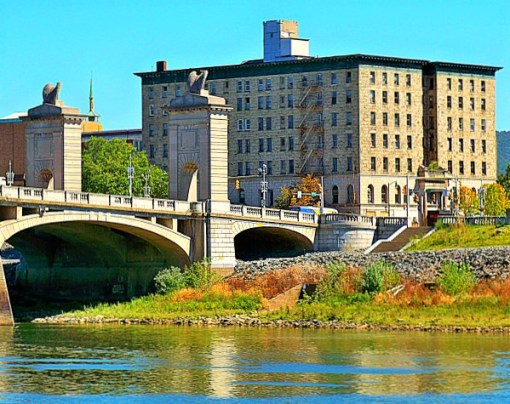
The House Of Fans
Wrong Turn

If you spend any time in Northeastern Pennsylvania, one thing that becomes evident is that everything and everyone here has ties to the anthracite coal mining industry.  The entire landscape has been permanently scarred by mining, and the reminders don’t look as if they will ever go away.  One such relic is the The Dorrance Colliery Fan Complex. 

Forgotten URBEX Chair at the Wilkes-Barre City Cemetery

Located on North River Street, right down the road from the long abandoned Hotel Sterling, directly behind the Wilkes-Barre City Cemetery and nestled along the Susquahanna River, remains the last portion of  the Dorrance Colliery.  For those of you outside of the NEPA region, a colliery is a coal mine and the buildings associated with it. 

 The Lehigh Valley Coal Company operated this particular colliery from 1880 until 1959 and this fan complex was there for all of it.  Fans were required for safety reasons, such preventing gas explosions.  (Ahhh, the good old days of mining coal with open flame lamps!) 

While this veritable death-trap of a fan house still remains, the actual coal breaker and the other buildings were demolished in the 1980s to make room for a personal care home. 


Are they 100% sure that tetanus can’t become airborne?  😉 

***2016 Update: Some of these structures were recently demolished

facebook

@@@@@@@@

Return To

GUERRILLA HISTORY Table of Contents


Cheri Sundra © 2012
All Rights Reserved