Posts Tagged ‘ abandoned ’

Hotel Sterling: History Deconstructed

Hotel Sterling:  History Deconstructed

Whose Version of History Gets to be Saved?

3

Featuring a “Grand Luxury” Finale

of Hotel Sterling Demolition Photography

by Steve Woitkowski of

Capture the Moment Photography Studios

9

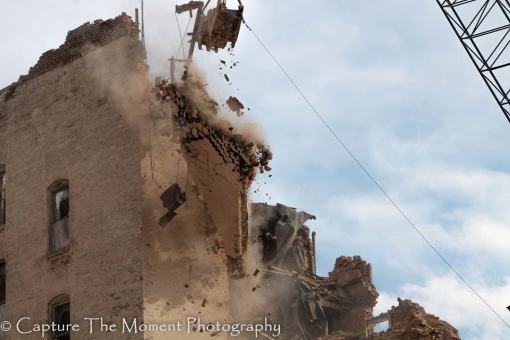
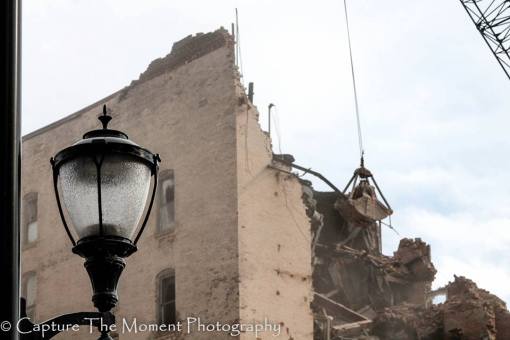
The definition of “history” is the past considered as a whole.  So until last week, the Hotel Sterling wasn’t “history”, it was actively part of the present.  The Hotel Sterling was still a “verb” in our community. 

This is what I find myself contemplating:   Considering that since 1964 the building had seriously declined way past the point where it was even being used as a hotel, which historical version of the building were historians and preservationists trying to “sell” to us as part of our collective history?

And, more importantly, whose history were they actually telling with that version?

Are there more people alive today, who have experienced the Hotel in the way that its history was being packaged for consumption, or do the majority of Luzerne County residents who are still alive, have a much different, and more important, history to recall about the Hotel Sterling?

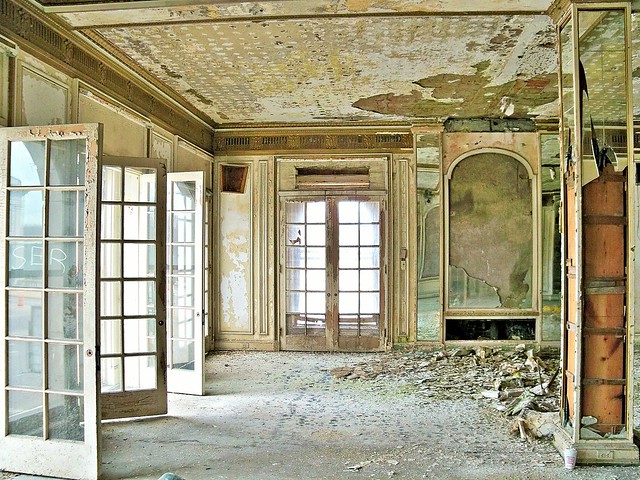
To me, as an Urban Explorer, documenting the fallout from the financial decline of our community, it represents something MUCH different than a fancy Grand Luxury Hotel where people used to dine in The Palm Room, and dance the night away in the ballroom.

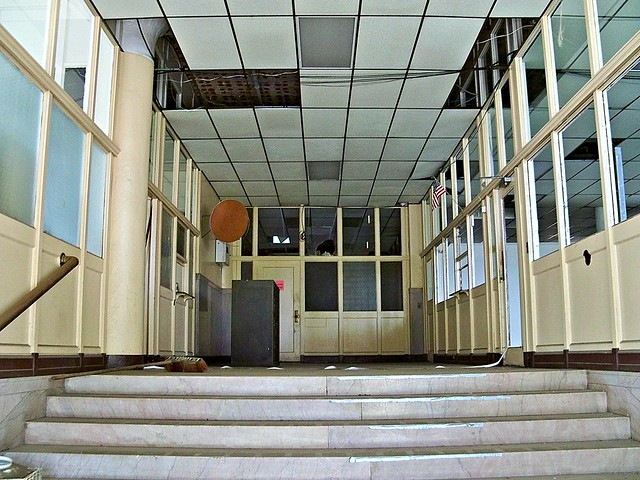
It's a Zombie Ballroom now at the Hotel Sterling

To most people in Generation X, Generation Y and whatever generation we are at now, the decrepit Hotel Sterling has never been anything close to that vision for them either.  In fact, for more than HALF of the years in the “life” of the Hotel Sterling, it looked NOTHING like the image that preservation proponents were trying to spoon-feed to the public.

Sterling 6

Sterling 2

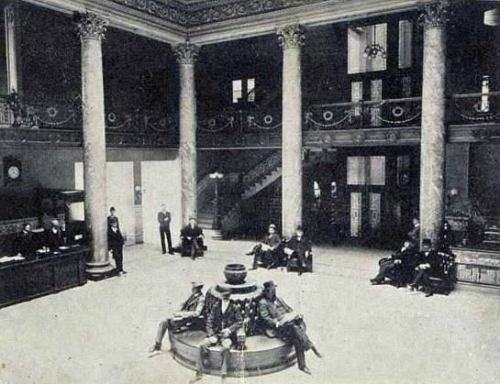
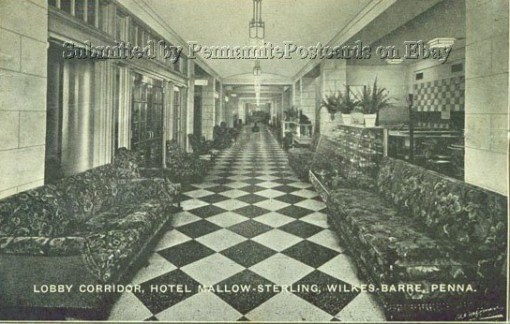
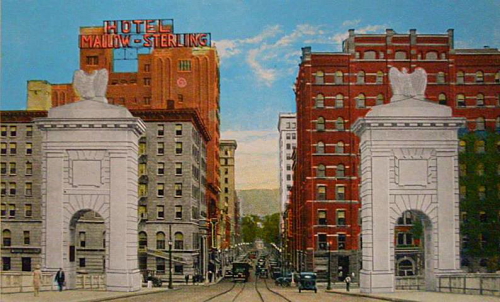
For the majority of her years as a part of Luzerne County’s history, the Hotel Sterling was not THAT hotel being portrayed by preservationists—that “history” is only true for the years occurring between 1897 and 1949, which is only 52, of the Hotel Sterling’s 116 years, as a part of the Luzerne County community.

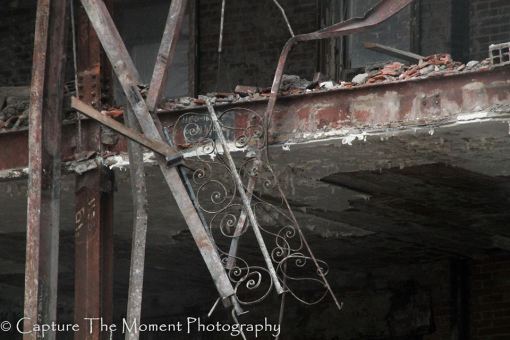
Then from 1949 to the day demolition began, 64 YEARS LATER, the reality is that the Sterling existed as a downgraded, community-centric version of its former self, until it eventually declined to the point of existing as a mold infested, water damaged, hunk of derelict, community resource pillaging,  real estate for the last few generations of Luzerne County residents to experience in the physical form.

How do you really interpret “collective history” when everyone’s experience, even of the physically present, can be so vastly different?  How do you ultimately decide whose “history” is most important to consider, and what gets to be documented, remembered and revered?

Sterling 7

Whose story gets to be told—the living or the dead?  The rich or the poor?  The young or the old?   And how long is it OK to put off creating the history of the future, in order to attempt to save the history of the past?

Sterling 9

I take real issue with people trying to sell any community on an historical preservation attempt that may not necessarily be in their best financial interest, based upon the assertion that buildings somehow ARE the heart and soul of that community.  Buildings and institutions are often more exclusionary in nature, than inclusive.   And I don’t mean that these places openly segregate community members in an overt fashion.  I’m talking about the kind of subtle socioeconomic based exclusion, that often goes unacknowledged by the people doing the excluding, but is felt at a core level by those being excluded.

Sterling 8

Obviously, the more affluent classes had wider access to the Hotel Sterling during its prime years as a Grand Luxury Hotel.  It was ultimately constructed strictly for the purpose of meeting the needs of the elite and business classes, while they were here in Luzerne County, exploiting the lower classes for profit. Working class people didn’t have the financial or social privilege of accessing that “string orchestra/Lobster Thermidor” version of the Hotel Sterling nearly as often as the wealthy got to have it.  The coal miners, for example,  with their dirty clothing and soot covered faces couldn’t belly up to the bar on their way home from work, to throw back a few beers, next to the same kind of people who were exploiting them for profit.

Sterling 3

Sterling 1

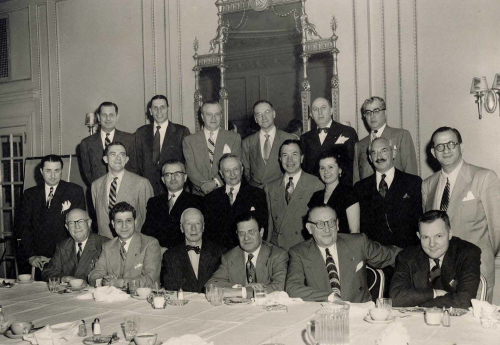
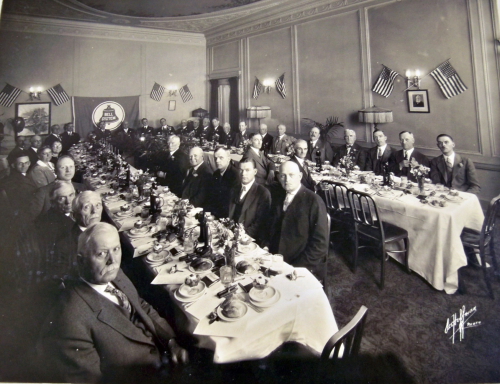
Sure as the “Grand” version of the Hotel began to slowly devolve, it became more inclusive to a larger portion of the Luzerne County community, as a venue for social club meetings and high school graduations.  More people of a different class structure began mingling at the bar. 

Sterling 4

And as the decline to eventual abandonment continued, the now decrepit Hotel Sterling became low income housing for the elderly, including some of those coal miners.  But much like the version of the Hotel Sterling that they lived in then, the retired coal miners were also slowly dying, because of the now diseased lungs that were inflicted upon them, as they worked for the people for whom the very Hotel Sterling was constructed,  for use as a Grand Luxury Hotel, and then cast aside, like the workers themselves, when no longer useful.

Sterling 5

Hotel Sterling Lobby During the 1972 Agnes Flood

And even at that point, a large portion of the Luzerne County population was STILL excluded from access to the now decaying Hotel Sterling,  based upon a different set of socioeconomic and age restrictions.  Until the day came when the doors closed for one last time, and an entire generation went through life in Luzerne County, with no active access to the Hotel Sterling whatsoever.  At least not by walking through the front door!  😉

Abandoned Hotel Sterling: The Harsh Light of Day

The Harsh Light of Day

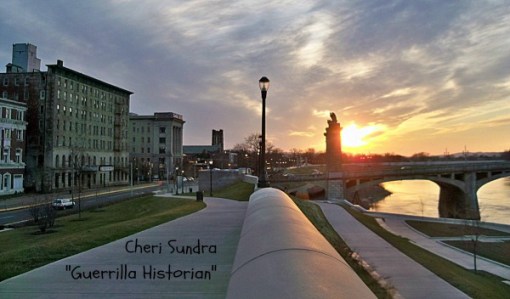
Cheri Sundra–Guerrilla Historian

Actually, you could make a strong argument for the fact that the Hotel Sterling has robbed Generation X and Generation Y , of their own shot at experiencing a “Grand Luxury” version of their community and their future, because a blighted structure, with little hope of successful redevelopment, lingered for too long, on a prime parcel of real estate, impeding future economic growth in their hometown.   THAT’S the version of history that ALL of us will recall about the Hotel Sterling, and unfortunately, it’s the history that will have the most impact upon Luzerne County’s future.

Picture 23

Sterling

6

Photo Credit:  Steve Woitkowski

2

Photo Credit:  Steve Woitkowski

1

Photo Credit:  Steve Woitkowski

5

Photo Credit:  Steve Woitkowski

4Photo Credit:  Steve Woitkowski

7

Photo Credit:  Steve Woitkowski

8

Photo Credit:  Steve Woitkowski

10

Photo Credit:  Steve Woitkowski

~*~

Return To Guerrilla History

TABLE OF CONTENTS

Cheri Sundra © 2013
All Rights Reserved

The Hotel Sterling: Five History Lessons

The Hotel Sterling: Five History Lessons

(What is history REALLY telling us?)
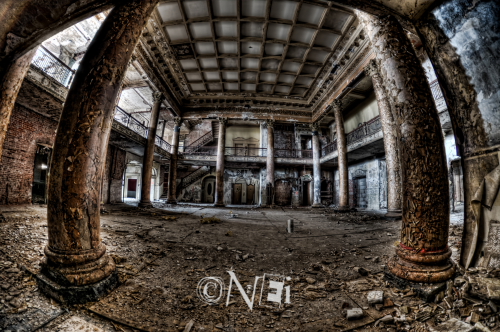
Featuring the photography of Dawn Robinson & Stacy Shannon

With Ed Mountjoy of The Forgotten Places of NEPA, who ultimately  gets the last word!

DawnPhoto Credit: Dawn Robinson of Nocturnal Echo Imagery

About a decade or so ago, it was trendy in declining communities to sell people on the notion that historic preservation was the ticket to imparting eternal life. But as the literature of those who try to cheat death has shown us, the bid for immortality can come at a huge price.  While the walking dead may be all the rage in pop culture, no city wants to find itself plagued by zombie buildings, a term being adopted nationwide to describe the disease afflicting places where buildings are difficult to lease, or sell, because they are in physical disrepair, and their owners lack the resources to bring the building up to code .  Unfortunately, using millions of taxpayer dollars that were supposed to be spent on our city’s financial resuscitation, it appears that Wilkes-Barre has created a Zombie Hotel instead. 

The demolition of the once grand Hotel Sterling really only leaves one question–Why?  Why do beautiful things fall to disrepair?  Why did our community allow this place, with such a romanticized past, fall to ruin?  Why did this beloved building turn into a memento mori of Wilkes-Barre’s prosperity?  

StacyPhoto Credit: Stacy Shannon

Every time a historical landmark is left to die, a community is left   to confront failure.  The building failed to live up to expectations, the owners failed to maintain the structure, and  the community leaders failed to create a local market that could sustain successful business development.   Sadly, happy stories of rehabilitation and rescue are few and far between for the majority of places across the nation.  Instead the failure to preserve historic landmarks seems to be serving as the signal of the kind of economic collapse that begins with the start of a zombie building apocalypse in struggling communities nationwide.

Northeastern Pennsylvania’s three largest cities, including Wilkes-Barre, are currently standing on the ledge, looking into the abyss of financial failure.  Decades of arbitration-mandated labor-related costs are rising faster than tax revenues, large numbers of untaxed buildings are owned by nonprofits, and stagnating tax bases are deeply rooting these communities into the same dire financial situation that has contributed to the total collapse of cities like Detroit and Camden. 
Dawn 1

Photo Credit: Dawn Robinson

About a decade ago, Wilkes-Barre’s leaders presented our community with a big plan that was supposed to save it from the same fate facing her two sister cities–Scranton and Hazleton.  This agenda, primarily consisting of historic preservation, was called the “Susquehanna Landing” project.  The plan included a newly renovated Hotel Sterling packed with shiny new residential units.  There would be yet another city parkade built which would somehow become part of the Luzerne County owned, and still vacant, Springbook Water Company, located behind and to the right of the Hotel Sterling.  There would be a museum in the still vacant Sterling Annex building,  which would connect  via some elaborate, elevated walkway system, to some newly built conference center that would somehow be linked to the still vacant Irem Temple, which is currently owned by the Chamber of Commerce. 

What was ultimately missing from this plan was a NEED for all of this redevelopment in the first place.

Hotel Sterling Historical Lesson #1—Create a Need

You construct your vision around a need that already exists.  You don’t attempt to build something that you hope will create one.  When the Hotel Sterling was built, droves of immigrants were motivated to cross the ocean to come to Luzerne County to work in our mining industry.  Coal was King and trains were depositing, and retrieving, large gatherings of business men at the train station on a daily basis.  It was because of this activity, that the Hotel Sterling was actually constructed.  These people needed somewhere to sleep, have meetings and entertain while visiting Wilkes-Barre for business purposes.   We didn’t build it in the hopes that they would come, we HAD to build it because they were already here!  If you don’t have a solid and identifiable need for your Susquehanna Landing-esque “vision of the future”, you have to begin by creating the “need”, not the vision. 
 Dawn 3

Photo Credit: Dawn Robinson

Hotel Sterling Historical Lesson #2—Look to the future, not the past

I am puzzled by the sentimental idea that we are “losing our soul” with the demolition of the Hotel Sterling.  No structure is the “soul” of a community….especially one that was built to cater to the rich and business classes, in a community that was predominately built by the exploitation of the working class.  In fact, it was BECAUSE of the working class that this structure was brought into existence, because the coal miners created the NEED for the Hotel Sterling.  BUT the coal miners, with their dirty clothing and soot covered faces would have surely been turned away if they showed up at the Hotel during the luncheon hour, or for a few beers at the bar on their way home from work.  When it was first built, the Hotel Sterling was strictly a venue constructed for “the 1%” exclusively, unless you happened to work for the Hotel.

Sure, as the place began to decline, it became more community-centric and the average person may have found themselves there, once or twice, for the occasional prom or office Christmas party.  But when we look back upon idealized memories of the Sterling, those usually aren’t the recollections that are looked upon with great historical significance, unless of course, a President or other famous figure happened to be passing by or staying at the Hotel.

Stacy 1Photo Credit: Stacy Shannon

And certainly, no one is looking back fondly at the last years of the building when it was still active, but had declined to the point that its only viable use was as low income housing.  No, this is a venue that historians like to recall with tales of string orchestras and Lobster Thermidor, not financially struggling elderly people existing in a building that was declining around them. 

What about the people who never had the chance to experience the Sterling at all, if it is the “soul” of our community?  What if you live in Wilkes-Barre and came of age AFTER the Hotel Sterling shut its doors forever?  Have those young people existed in a soulless community?  Doesn’t anything that they have grown up experiencing in Wilkes-Barre matter at all?  It’s silly to attach such extreme value to a building. Especially when history has taught us that great economic growth, as well as our future, is often connected to the creation of new buildings full new memories for the up and coming generation.
Dawn 6Photo Credit: Dawn Robinson

Once upon a time, there stood a music hall, where popular plays and musical comedies were performed.  People of that community remembered that venue fondly, sitting at the gateway to Wilkes-Barre.  Then the day arrived when that parcel of real estate seemed far too valuable for such a singular venue, and the music hall was demolished to make room for the Hotel Sterling.  After all, the Hotel was needed to meet the requirements of the growing population and industry that was knocking at the door of Wilkes-Barre. 

People looking towards the future; spend little time dwelling in the outmoded needs of the past.  We need leaders who think about our future!  You never have to mourn the loss of your past, if you are replacing it with a future that is brighter.  Only communities that lack hope for the future, cling so desperately to their “glory days” at all costs!


Hotel Sterling Historical Lesson #3—Historical Preservation

as an agenda does not assure a successful redevelopment project

It’s interesting to note that Preservation Pennsylvania, along many other preservation centered organizations, is NOW issuing recommendations about assessing financial feasibility when considering Historical Preservation Projects.   Many see this as a reaction to the failed trend in pushing historic preservation as a redevelopment plan in declining communities, as well as the fact that economic conditions nationwide are signaling an overall decline in America’s financial health.  Historic Preservation of a long-term vacant building is ALWAYS ultimately more expensive than new construction.

 In the publication, “How To Protect and Preserve the Historic Places That Matter to You, Preservation Pennsylvania provides a series of “reality checks” for assessing a project’s financial feasibility, a topic that often goes unmentioned when emotional attachment reigns during community discussions that involve “saving” beloved landmarks.  In fact, those pushing a “preservation agenda” will stop at nothing to see that a building is “saved” in the name of “history”, even if it requires completely stripping EVERYTHING from the structure that contributed to a memorable experience at that location, just for the sake of saving nothing but the shell of a building.  That’s an expensive proposition that will not be economically feasible for building owners and developers to entertain in communities facing financial issues like Wilkes-Barre.   

Stacy 5 Safe

Photo Credit: Stacy Shannon

In a section titled “Reality Check—Know when it’s time to walk away”, Preservation Pennsylvania says “There is no formula that can be used to determine when to call it quits, but if you are honest with yourself, clear on your objectives, and really understand the limitations of your resources, you will know when it is time to congratulate yourself for making the effort, learn from what didn’t work, and walk away.”  

I was recently asked whether or not the Hotel Sterling should have/could have been saved, in an interview for 570 Mine Fire.  Here is a portion of that interview:

“I’m a realist. I believe that the biggest error was in not demolishing the Hotel Sterling sooner. I do not believe that it was ever financially savable, even way back when it was still structurally savable. And both components have to be there in order to create a successful outcome in a preservation attempt. Just because a structure is historical, does not mean that it will result in a successful redevelopment project. I think that when CityVest ran out of their first batch of funding without a developer in sight, that the community should have just congratulated them for their efforts, and called it quits right there. But instead we found a way to find them even more money, despite the fact that developer after developer kept passing the project up for structural reasons.  According to one newspaper report:

“Among the building deficiencies identified by developers: Low ceiling height, compromised views from small windows, an inefficient layout for use as residential or hotel units, unusable space created by the large lobby and atrium, inconsistent floor elevations on the second floor, narrow elevators that don’t comply with the Americans with Disabilities Act, concern that replacement of the floors could risk structural instability of the building because of the way the floors are anchored to the building’s perimeter walls.”– “Sterling’s Fate in County’s Hands”, Times Leader, April 16, 2011

But as a community, we just kept going on this “preservation agenda” relentlessly. Given my short-lived experience as an activist for the building, I see how a fever begins to spread that ultimately builds these building owners up for a success that will never be realized because it is being built upon a false premise.  When I first started asking community leaders about what we could do to save the Sterling, most of them responded with “Tell the owner that you want to rent an apartment or commercial space in the building.” Which I found really weird, because I’m not a business owner and I don’t want to live near Market Street, so when I would push for a different answer or more information, they would tell me that it’s just what you do if you want to save a building.

Knowing that, while reading through old newspaper archives about the preservation project, one quote from the paper really stuck out in my mind:

 “Without any formal marketing, CityVest board members can’t go to any functions in town without somebody expressing interest”, Rogers said.” – “State Ensuring Preservation of Hotel Sterling’s Legacy:  Bureau for Historical Preservation Will OK CityVest’s Progress”, Citizens’ Voice, June 7, 2005

Were these people also being told to falsely tell CityVest representatives that they wanted to live/work in the building? And if so, would CityVest have stopped redevelopment plans sooner if there wasn’t this “false” community buzz about the project that didn’t reflect ANYTHING about the local economy or real estate market? I guess we’[ll never know, because with all of the finger-pointing going on, I’m sure no one affiliated with CityVest will ever agree to publicly talk about the failed project.  Which is a shame; there is a lot that we as a community could gain by having that discussion.”

Hotel Sterling Historical Lesson #4—Know when to walk away

While well intentioned,  the Hotel Sterling preservation seemed doomed almost from the very beginning when you take the time to look back over newspaper coverage concerning the project from the very beginning. (You can find excepts of this newspaper coverage (contained in another post on this site)  While many people blame the failure of the project on CityVest, the last owner of the Hotel Sterling, it is obvious that evidence clearly suggested that a positive preservation outcome may have been highly improbable to achieve in the end.  It is striking to realize that local journalists were referring to the structure as decaying and decrepit as far back as 2001—a red flag about the magnitude of the project itself and the funds required for completion.

Dawn 10Photo Credit:  Dawn Robinson

Another red flag that should have slapped our community leaders directly in the face was the fact that developer after developer passed on the project.  We should have just STOPPED at the point where funding had been exhausted with no developer in sight willing to take on a $32 million dollar historic preservation project.  But the hubris-filled love of our past, found our leaders scrambling for even MORE FUNDING  in order to declare the owners of the structure, CityVest, the “the developer of last chance”.   The fact that the newspapers were using that phrase should have signaled “danger” to the community at large. 

The entire concept for the Sterling project (& the other historic structures included in the “Susquehanna Landing” vision) may have been too “high-end” for the reality of the Wilkes-Barre real estate market. For years, the public was being sold on an upscale vision, when in reality, that market/location has only attracted volunteer services and companies specializing in addiction rehabilitation.

Another issue that was hinted at from the inception of the Sterling project was that Wilkes-Barre’s reputation for corrupt political dealings was going to make it difficult to attract serious developers who wanted to invest in our community. Since that time, we all know that things have only taken a turn for the worst—“Kids for Cash”, need I say more?!  The fact remains that the preservation enthusiasts in our community  need to consider the real-world obstacles that Wilkes-Barre faces while moving forward with any more projects now, or in the future. 
 Stacy 6

Photo Credit: Stacy Shannon

When historic preservation is discussed in Luzerne County, the conversation is very one-sided, and usually consists of attempts by preservationists to guilt the public into letting proponents have their way by insisting that people “don’t value history” if they are against a restoration project. It’s time to get real about historic preservation in Luzerne County. The fact is, that because of changes in the structure of the global market and the national economy, communities that have not been investing wisely in their history when things were really good, are going to lose a lot of that history now!

It makes more sense to maintain structures BEFORE they become long-term vacancies, than it does to attempt to engage in heroic “life saving” measures after the fact.   Like it or not, “saving history” is a big ticket project that requires the help of outside private developers who are going to be looking for a return on their investment. And while there are plenty of entities who will encourage communities to move forward with such projects, there are none who will assist them in assessing the situation beforehand to see if such a project is even viable in the first place.

HISTORIC PRESERVATION in and of itself is BIG BUSINESS. Who can we count on to tell us when taking on a project may not be feasible in our community? Is the consulting firm hired to market the project going to do it? Are all of the architect firms that stand to benefit from the proposed project going sound the alarms? Will non-profit entities such as Preservation Pennsylvania, who earn their keep pushing a preservation or “history” agenda, do it?  NO. 

Stacy 2Photo Credit: Stacy Shannon

When Wilkes-Barre discusses historic preservation, the conversation always seems focused on the structure itself and what CAN be done (& believe me, SOMETHING can ALWAYS be done) to save it, but no one ever seems to  question what SHOULD be done when all of the external factors are considered.
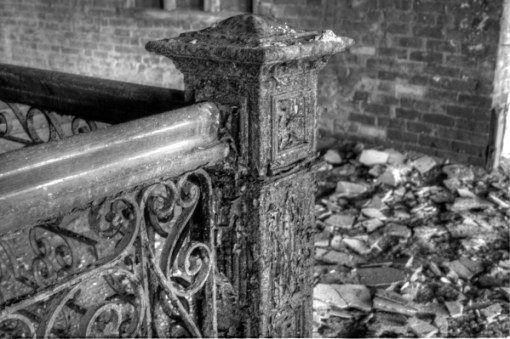
Stacy 4Photo Credit: Stacy Shannon

Many components need to be in place in a community to successfully complete a multi-million dollar historic preservation project. What in Luzerne County has changed that would make success in ANY expensive historic preservation effort a possibility today? I hope I’m wrong, but I don’t believe that anyone has an answer to that question as our community is now faced with deciding what should happen to the entire cluster of vacant “Zombie” historic buildings inhabiting the city block once designated for the “Susquehanna Landing” community redevelopment vision.

The fact that all of these vacancies even exist  is quite mind blowing,  considering that they have been sitting, untouched for years, just one block away from the epicenter of Wilkes-Barre, and also one block away from the city’s institutions of higher learning.  And just like the owners of the Hotel Sterling, the owners of these remaining structures cannot afford to fix or maintain them either!  And sadly, the taxpayers technically own many of these buildings, thanks to someone’s failed plan that involved community entities buying them AFTER they became vacant!

Hotel Sterling Historical Lesson #5–Even when “zombie” real-estate is privately owned,

if the owner falls into financial dire straits,

the distressed building becomes a burden for the taxpayer

What a grand, public resource eating, Zombie Hotel the Sterling eventually became!  And this is often the case for all Zombie Buildings, even if they are historic!  People forget that just sitting there, doing nothing, these vacant buildings are costing SOMEONE money—usually the taxpayer in one way or another! Taxes are either being paid or are being forgiven.  Insurance premiums need to be maintained by SOMEONE.  The price of having vacant and blighted real estate littering the landscape can become an insurmountable burden for any city, scaring away prospective business owners and real estate investors. 

And now we are forced to ponder the ugly and expensive question about what needs to be done with the rest of the zombie real estate that has taken up residence within this same block, waiting for the day when our past was supposed to redeem our city in the present.  How many more parcels of the decaying remains of a by-gone era can our community possibly try to maintain before we push ourselves beyond the prospect of having any real hope for the future?
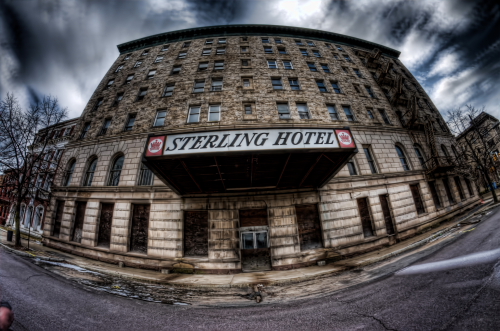
Dawn 8Photo Credit: Dawn Robinson

Today as we begin the process of dismantling our brick and fake marble corpse of innovation and prosperity known as the Hotel Sterling, we SHOULD mourn its passing because it was built to fulfill a need created by abundance.  Unfortunately, whatever we put there now, will ultimately be damned, because we will be building it out of desperation.    

We are a community, extinguishing our past in the present, and transitioning into what we will become in the future.  The Hotel Sterling is a story about the death of a chapter in American History that begins with the end of the industrial revolution.  For decades, our community has attempted to outrun our diminished expectations for a way of life that we can no longer hope to maintain.   The demolition of the Hotel Sterling should serve as a harsh wake-up call about our community’s impoverished current reality. At one point considered a monolith of our affluent class’s achievement, what remained was ultimately nothing but blight on our city’s landscape.  

~*~

ONE FINAL WORD FROM THE FORGOTTEN PLACES OF NEPA

Ed 1Photo Credit:  Ed Mountjoy

Ed Mountjoy, the face behind The Forgotten Place of NEPA on Facebook, had the extraordinary opportunity to watch the fireworks display at Kirby Park, from inside of the abandoned Hotel Sterling this year. (Way to go Ed!  You are my Urban Exploration hero!)  He explains:

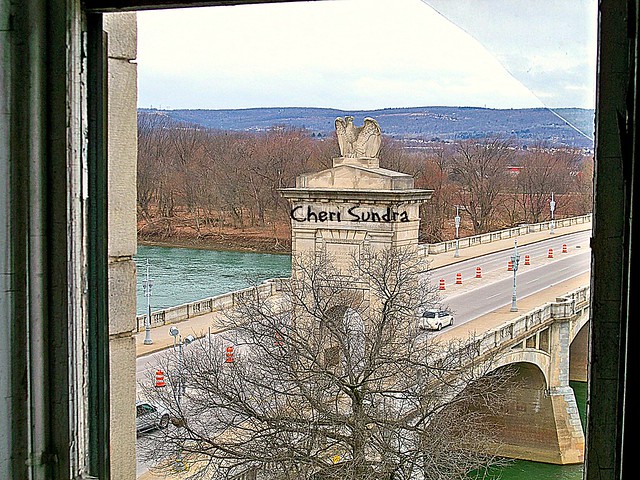
“Seeing the fireworks from the Hotel Sterling that night was surely something I don’t ever expect to forget. Being up there, on the seventh floor, sitting there by that window, which was missing its bottom part of glass, was an odd feeling. It wasn’t odd in a bad way, but odd as in that I could actually picture people doing the very same thing back when the Sterling was occupied. The fact that it was dark all around, except for outside, added to the feeling, since the darkness covered up the fact about how gutted and decayed the building really was. While sitting on the floor watching the fireworks, I could just imagine someone in that very room doing the same thing decades ago. It was a historic view that many got to see in the past and, with this passing Fourth of July, it would be the last time anyone would get this view, from this very building, of the fireworks. Knowing this would be the very last year, I knew I had to get up there to see them.”

Ed Continues:

“This is WHY I maintain The Forgotten Places of NEPA and The Forgotten Coal Industry of NEPA on Facebook.  Places like the Sterling, won’t always be around.  Many, if not all, of the places I’ve been to have meaning to at least someone, whether it’s a small building on the side of a barely used road or structures that occupy spaces at the busiest of intersections. At some point, people worked and/or lived in these places, people I am sure have relatives that are alive today, relatives that may wanna see where their ancestors worked/lived at. I maintain these pages to keep those memories as alive as I can and I’m sure others seeing these photos trigger memories of either them working/living there, or knowing about family and/or friends who worked/lived there. Many might think that my pages are strictly just about urban exploring, but it’s not. Granted, most my photos involve having to do so, but I do it because I know many who’d like to see such photos can’t go there themselves. I do so, not just to explore the locations and get piles of photos, even though that is the best part of the experience, but to, hopefully, trigger some memories from others and maybe even learn a little more about these locations from those people.”

 SANYO DIGITAL CAMERA

Photo Credit: Ed Mountjoy

~*~

Return To Guerrilla History

TABLE OF CONTENTS


 Cheri Sundra © 2013
All Rights Reserved


Hotel Sterling: The UnDead Days

Abandoned Hotel Sterling: A Room With A View

 Zombie buildings are real.  It was a term first coined by financial analysts to explain the national collapse of the commercial real estate market as far back as 2006, and has expanded to represent all buildings that are unusable due to disrepair, because they are owned by entities that are too broke to fix them.

Based upon “Hotel Sterling: The UnDead Days”,  Welcome To The Zombie Hotel Sterling is now available for digital download at Amazon.com!  If you don’t have a Kindle device, don’t worry, you can download a free Kindle app for your smart phone or computer right here!

Book Description:

Abandoned and rotting away along the banks of the mighty Susquehanna River, the zombified Hotel Sterling tells its tale of fading grandeur and woe to a photographer visiting the deteriorating structure, seeking to photographically document the reality of the condition of the building, as the hotel waits for its beloved community to decide its fate, once and for all.

~*~

Read an interview about “Welcome to the Zombie Sterling” at: 570 Mine Fire

~*~

Back To

Guerrilla History

Table of Contents 

Cheri Sundra © 2013
All Rights Reserved

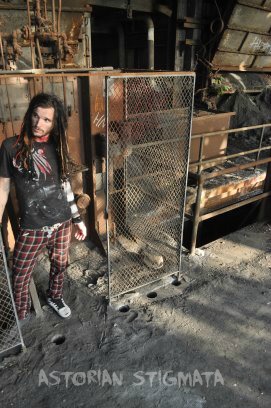
The Huber Breaker Rocks –with ASTORIAN STIGMATA

“Standing at the edge where beauty meets decay

Re-born through death

Time fades away and leaves a memory

But that red sky rests so quite

Upon the ashes of innocence

And some things never really come alive

Until after they have died.”

–“The Beginning Of An End”  (ASTORIAN STIGMATA)

Huber Breaker Ruins:  The Art of Industrial DecayThe Huber Breaker in Ashley,  Pennsylvania, USA

Sometimes, engaging in urban exploration is like experiencing an alternative reality.   In these abandoned and often beloved structures, ghost-like representations of what “once was” collide head-on with their current state of decay and ruination, representing a dream-like status between existence and non-existence, somewhere in the middle of life and death.  

Naturally, a local band with a name based upon the concept of an alternative reality, combined with the imagery of open wounds, and the catch phrase “Stay Dead”, would conclude that one of Northeastern Pennsylvania’s most popular urban exploration sites would be the perfect setting for filming a music video or two!  

As5

But according to Astorian Stigmata founder and front man, Dennis Condusta, his hometown, which is referred to as the “Victorian Corner of Pennsylvania” on the band’s Facebook page, always stars in his videos.  “I’ve traveled extensively and it has really helped me notice that Wilkes-Barre is a truly unique place in many ways”, Dennis explains, “Most of them aren’t positive ways, but in the architectural sense, it really has a “decayed elegance” feel.  Like it was once a prospering place during the coal mine era and now it’s kinda run down, and somewhat dismal.  I noticed over the years that the message in my music was very similar to that.  I’ve always been drawn to the concept of once beautiful things fading away.  I know that they always can return.   It’s kind of a positive way to look at decay and things falling apart. And “Victorian Corner” is just a reference to a lot of the Victorian era architecture in the surrounding area of Wilkes-Barre. I’ve always been drawn to its class, and most of our records have Victorian era houses on the cover.”

While discussing the Astorian Stigmata video “Ballroom Dancing, Condusta said that their European fans often make comments about how much they love the look of the old historical stuff here in Pennsylvania.  “Most of those shots (in the video) were right in the downtown area, the apartments across from the River Front, and close up shots of the Sterling Hotel”, he stated, “And the European fans say things like “I’d love to visit Wilkes-Barre!” Ha-ha. I think it has a lot to do with the way it’s represented”, he explained, “We really romanticized the place in all our work.  And people from here never realize how truly unique and beautiful a lot of the things we have around here are, mostly things left over from the coal era.  If we become a bigger band it’s going to be a good thing for Wilkes-Barre tourism!  Ha-ha.  It always kinda bugged me how bands move away from their home to embrace the music scene other places or whatever, and that’s all fine.  But I see myself as an artist far before a musician who is trying to “make it” or anything like that.  So I do my best to represent the area I am from because it has played such a huge part in my artistic understanding of the world around me.”

Abandoned Hotel Sterling: The Harsh Light of DayThe Hotel Sterling ruins in Wilkes-Barre, Pennsylvania, USA

Condusta came up with the band name in 2003 while watching an HBO show called “Carnival”–specifically,  an episode titled “The Road to Astoria”, when he became intrigued by the idea of an alternative reality, but one  very similar to the one we know. That “alternative reality” notion  is the main reason I chose to write about Astorian Stigmata for my blog about urban exploration, because that is the very concept that urban explorers are trying to capture when they photograph the abandoned structures where people once lived, worked, played, worshipped, dreamed or suffered. 

AS2

Condusta was drawn to the word Stigmata for its powerful look and strong pronunciation.  Which is a relevant choice, because the visual images portrayed in many of the band’s videos are both harsh and destructive.  Yet, in listening to the lyrics, you can’t miss the sentimental vibe—like a verbalized wish that life was less fragile and that people, places and things could be more permanent.  

Dennis explained that “most of my lyrics are about dualities.  Which is also why we use black and white stripes so consistently in our logo and branding—they represent the ups and downs of life, and that they are both equal, and both present at all times.”    Many of their song lyrics are quite philosophical, touching upon concepts such as being “re-born through death”, as in the lyrics of the one video filmed at the Huber Breaker.  “It refers to an existential death and coming back to life as a better person, but only after your old sense of self has died”, Dennis stated.  Fans consider the band’s catch phrase, “Stay Dead” and their entire “death” theme, as a metaphor for the kind of self-fulfillment that leads to happiness by remaining true to yourself.

In fact, staying true to themselves is even embraced by Astorian Stigmata in their business model, because they literally do everything themselves.  Dennis explains that being an “indie” band allows you to do things, your way, all the time, when you want. We’re pretty specific about what we are trying to say and do.”  According to Dennis, “I’ve always loved design/photography/hand printing t-shirts/video/editing/music recording/writing and production–even the hard work like hand making every CD. Our guitar player, DJ, is the same way. He  enjoys it all and we work well together as a team. We don’t call ourselves a “punk” band, but we carry that flag and ethic as hard as anyone.  Not because we want to, but because no one is gonna do anything for us.  We’ve been offered record deals and things, but we’re not dumb dudes in a band. We understand how business works, and how things happen, and that 90% of the industry side of music is there to fool you into making them money.”  

Condusta further explains that as an artist, his focus isn’t the same as that of a corporate business entity, only interested in creating mainstream conceptual “art” that is made popular for the purpose of selling it quickly, “We make lasting art. Songs we wrote 5 years ago have as much relevance now as they did then, and will still be relevant 20 years from now.”

AS1

Dennis Condusta became interested in playing guitar at a young age, because his older brother also played.  As luck would have it, he won a guitar when he was 16, at a BMX riding contest.  He was influenced by the music of Modest Mouse (“Dramamine”) and Taking Back Sunday (“A New American Classic”) plus a strong desire to create his own music.   “I have no interest in learning cover songs.  I just knew I had a feeling inside me and I wanted to learn to get it out as fast as possible”, he said.  Dennis also states that his most important influences are his brother and his friends. 

Condusta, a life-long resident of this region, known for its working-class sensibilities, which are often hallmarked by the suppression of individualism, did note that this area sometimes has a lack of respect for a broad variety artistic expression.   Still, he credits this area for helping him to form his artistic vision, and openly accepts the responsibility and challenges required to act as the ambassador of his own vision, “I do not see that as their fault for misunderstanding me, I see it as my own fault for not doing a good enough job at being understood.  I am not afraid to dress strange or to wear two different shoes, it reminds me not to take life too seriously. You’d probably be surprised at how little people notice/care about how crazy someone looks if you do it confidently.  It’s when you feel uncomfortable or out-of-place that people can sense it, then they insult you.”

As6

Much of our local history is dark and reflective of the oppression of the human spirit, because for a long period of our recent history, the area was monopolized by an industry that told people daily that they did not matter.  In fact, the mules that worked in the anthracite coal mines were insured, while the humans laboring there were not!  Local workers had to resign themselves to the fact that they were being exploited, just for the opportunity to earn a paycheck.  “That coal miner mentality is still engrained in the people from this area. I think it plays an enormous role in the art I create, so I respect it very much and choose to embrace it”, Dennis said, “There is a dark cloud of oppression that just sits over this valley, although it’s not strong enough to keep me down in any sense.  I find it comforting– in a totally sick and twisted kinda way. Ha-ha”

One of the prominent remnants of the coal mining era, the Huber Breaker ruins, has a starring role in two of Astorian Stigmata’s videos. (For those of you outside of Northeastern Pennsylvania, a coal breaker is literally a place where the coal that was brought up from the mines was broken into smaller pieces using machinery.) This location is popular with urban explorers because they love to photograph the machinery and vanishing points that are contained within the decaying walls of this now obsolete industrial complex.  I asked Dennis to explain the inspiration behind using this location for these videos.  “It’s one of a kind”, he said, “And it’s in rather good shape for how old it is.  That place has a feeling and a beauty to it I’ve never felt anywhere else.  It’s special in that sense and it’s really inspiring in many ways. It’s hard to explain.”

AS4

I asked Dennis if he thought that exposing non-history buffs or individuals unfamiliar with our local history, to our historic locations in a non-traditional artistic context is a good way to inspire an interest in the subject matter.  “Yes, I do”, he responded, “Our target audience has never been local.  We’ve always strived to appeal to a worldly audience.  Most local people think the Huber is played out, ‘cause they’ve seen it so many times, but there’s a person sitting in Norway right now watching that video thinking that’s the coolest place they’ve ever seen.”  

And believe me, he’s not kidding!  One of my personal, most interesting experiences with the Huber Breaker includes running into a group of students from Germany, taking pictures of the Breaker, as one of their stops on an “Urban Exploration” tour of the industrial ruins along the east coast of the United States!

I asked Condusta, a descendent of coal miners himself–both of his great grandfathers were employed by this industry–if he had any thoughts about using a place where men, and even little boys, were oppressed and exploited to express himself artistically.  He said, “Yes, I always think of that.  And sadly the world still works that way.  I always kinda wished people knew the background on the industry and of that place ‘cause it would add a whole new dimension to the message I’m trying to send.”  Although Dennis maintains that the videos and pictures are primarily for aesthetic purposes, and produced for a world-wide audience who does not see such places as they go about their daily lives.     “While I understand and respect the history personally”, Dennis explains, “I don’t expect someone in Spain to think of that.”

AS3

Of the two Astorian Stigmata videos filmed at the Huber Breaker, “The Beginning Of An End” is the most artistic in nature, and therefore open to individual interpretation.  I thought it would be interesting to analyze the video/lyrics within the context of the historical setting with Condusta. 

The start of this video features a guy in a camouflage suit collecting water samples from this industrial site in a post apocalyptic world.   I found it somewhat poetic that in the beginning of the video you hear “stay safe”, because the irony is that for the men who worked at that dangerous site, in such a high-risk industry, that’s what they, and their loved ones, were thinking every day.  Dennis found that interpretation interesting, but said that it wasn’t quite what he was thinking while creating that scene for the video.   The video also features a vampire, which I interpreted as a representation of the coal company literally feeding off of the coal miners to turn a profit for themselves, while their employees often lived in impoverished conditions.

The song lyrics contain the phrase “where beauty meets decay”.  I asked Condusta if he thought there was something tragically beautiful about this specific abandoned industrial site.  “Yes, most certainly”, he said, “It’s symbolic of what was once flourishing, busy and a source of life and jobs for an entire city. And now it’s pushed aside and forgotten. That’s the central theme of my artistic being.”

I asked Dennis why he chose to end the video with the sound of a laughing child.  “That was just to provide and exaggerate the feeling of unease that I was attempting to convey”, he explained.

The video “Strange Nights (Live From The End Of The World), was also filmed on location at the Huber Breaker.  I asked Condusta if there was something about the location that promoted an “end of the world” feeling.  “Yes”, he responded, “It reminds me of what the world would look, and feel like if it were to suddenly end. I found a worker’s time card in the breaker dated from 1962.  It’s just interesting to think about how so much of that place seems like the workers just walked out at the end of the shift, and didn’t come back. It doesn’t feel like it ever planned to close–it has a feeling of unrest.”

In conclusion, I asked Dennis if there was anything that he wanted people to know about himself or Astorian Stigmata.  “Myself personally?  I’m not a terribly interesting person”, was his response, “I put my life into art and I ask for nothing in return. I don’t do this for money/fame or reputation. I was just born with a soul that needs to express itself, and I hope somewhere along the way someone else gets some enjoyment from the work I do.”

You can find more information about Astorian Stigmata by visiting their official website  and  Facebook page .   

Max 3

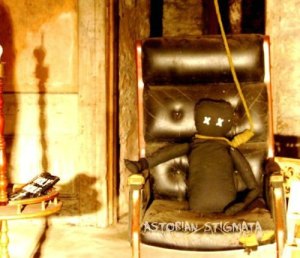
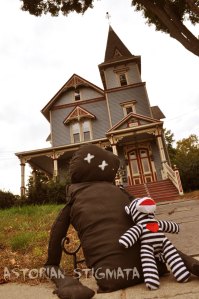
Maximilian Aladar was born on May 28th 2005.  He is the creation of Dennis Condusta who was in need of someone to play the drums for his band, because at that time, he was playing all of the instruments himself on the recordings.  Dennis made Max that very night, never finishing his legs or giving him a mouth.  This way, Max could not talk back (using words) or run away.  Today, Max serves as the guide for Astorian Stigmata.  He is the puppet master who is a puppet…..

Max 1


Back To

GUERRILLA HISTORY

Table of Contents

Cheri Sundra © 2012
All Rights Reserved

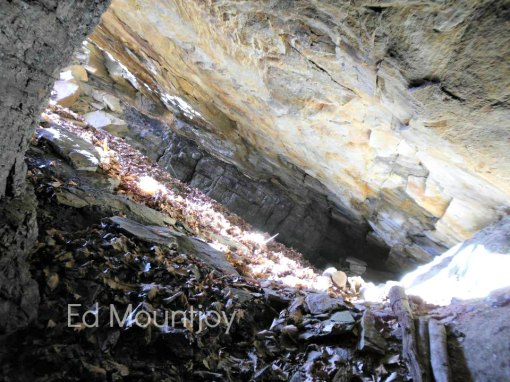
Into the Belly of the Beast: Exploring The Mines That Fed The Industrial Revolution

Disclaimer:

I feel the need to have one of those “Beavis and Butt-head are not role models. They’re not even human, they’re cartoons.  Some of the things they do could cause a person to get hurt, expelled, arrested… possibly deported.  To put it another way, don’t try this at home” warnings at the beginning of this post.  

While Ed Mountjoy is NOT a cartoon character (although some may disagree), what he does is EXTREMELY DANGEROUS, and you should just resign yourself to enjoying his adventures from the safety of your computer/smartphone screen.  But since urban explorers tend to view “No Trespassing” signs as invitations to enter, I won’t bother coming up with a disclaimer of my own….I’ll just stand by what Mike Judge said, just insert Ed Mountjoy and abandoned anthracite mines for yourselves!  😉 

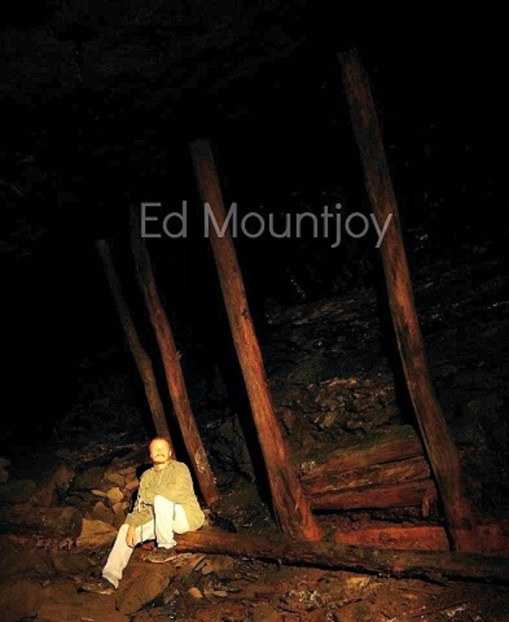
Ed First

Many Social Media users in Northeastern Pennsylvania (NEPA) recognize Ed Mountjoy as the face of The Forgotten Coal Industry of NEPA’S Facebook page.  But Ed’s following is quickly spreading beyond the “coal region” of Pennsylvania, and into the realm of the world-wide network of urban exploration.  And understandably so, since within the “explorer” hierarchy, those who explore the territory below the earth’s surface definitely carry more prestige than those of us who remain steadfastly with our feet planted above the ground. 

Ed 2

While there are coal deposits scattered about the world, the coal from Northeastern Pennsylvania  is special  because it is anthracite coal, which is more pure, harder, and of higher carbon content than any  other type of coal on the entire planet.  In the Western Hemisphere, 95 percent of the anthracite coal supply is located within the 500 square mile region of Pennsylvania that is the topic of Ed’s “Forgotten Coal Industry” Facebook page. 

The story of anthracite coal mining in NEPA is complex.  It’s about pioneering industry and the entrepreneurial spirit, as well as the darker side of greed, suffering, and human exploitation. During the coal era in NEPA, the elite Coal Barons (coal company owners, a.k.a. The 1%) built magnificent Victorian mansions, as their immigrant workers often lived in overcrowded, company-owned “patch towns”, while actually having to pay their employer for the supplies necessary to do their high-risk  jobs that resulted in earning less than what we would call a “living wage” today.

 The coal mines of Luzerne County have been abandoned for decades now, but Ed Mountjoy is on a mission to document and share whatever remains he can find that relate to our local coal mining history before these remnants are gone forever—especially those places or structures that are hidden away from us as we go about our daily modern lives full of urban sprawl. 

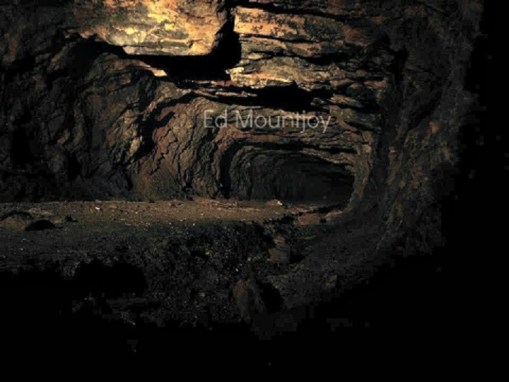
While many urban explorers have documented popular local coal-related locations such as the Huber Breaker and Concrete City, Ed ventures into an area of local exploration that you never really hear about—the actual anthracite mines themselves.  Since exploration is ultimately about documenting the remains and ruins of the places that touched the lives of the people who once lived, worked, worshiped, or played at these locations, Ed is honoring the men who worked in these coal mines by reminding us all about the physical reality of their confined work-space. 

A Slope Leading To A Flooded Mine

A Slope Leading To A Flooded Mine

One truth remains the same today as it did for the men who toiled daily underground decades ago in NEPA–anyone entering a coal mine faces many dangers such as underground floods, roof falls, a mine collapse, fire, and countless other methods of serious injury or death.  A coal mine is not a glamorous place to be at all. The men working underground found themselves in an environment that was dirty, dangerous and most likely damp.  Standing up straight is almost impossible because mine tunnel ceilings are too low.  The air that you breathe in a coal mine is stale & dusty.  The miners actually had to use pieces of lumber to prop up the roof in the area that they were working in, as an attempt to avoid being trapped or crushed by huge rocks.  This knowledge gives anthracite mine explorers an adrenaline rush when something seems out of the ordinary during a mission.

“During a recent exploration, we thought we were hearing part of the mine collapsing, but it turned out to be some rocks sliding down an incline we just went up. That scared us but we were relieved to know it wasn’t the mine collapsing”, explained Ed.

Ed began seriously exploring abandoned anthracite mines at the end of 2010.  He had explored the remains of two collieries (for those of you outside of the NEPA region, a colliery is a coal mine and the buildings associated with it) as well as other abandoned buildings as far back as 2006, so he was already interested in abandonments.   “ I was informed about two mines and originally was just going to find them and get exterior photos of the openings into them”,  he explained, “ After several attempts looking for them, we, a friend and I, found them and saw they were low mine openings, meaning you have to crawl to get inside. We decided to enter them and the interest just sparked from there after seeing what we had inside of those two low mines.”

When asked how he finds mines to explore, Ed responded, “Well, I normally do research about what mines were in opperation around a particular area before exploring.  Sometimes, we’ll just run across a mine and, after exploring, will do research afterwards on what mines they may have been and what companies owned them during their years of operation. As for preparing to explore one of these mines, we’ll examine the conditions of the opening before entering; making sure the ceiling isn’t in horrible condition.”

Props Holding Up Mine Ceiling

Props Holding Up Mine Ceiling

As far as equipment goes, Ed approaches mine exploration on the lighter side by just carrying a flashlight, camera, tripod, and a drink.  He is also sure to take someone else with him. “I NEVER explore any place alone”, he stated, “I always have at least one other willing friend who comes with me. You never know what can happen when exploring any abandoned place, and mines are no exception.”

I wanted to know if he ever got lost while engaging in his underground exploration adventures.   Ed’s response was that he has never been lost, not even while exploring the largest mining system that he has been in, “I have a rather good sense of direction and can retrace my steps back, plus some of the mines still have arrows painted on the walls and ceilings pointing to the exit from back when they were mined”.  

I was curious to know what Ed considered to be the most difficult aspect of this type of exploration.  “Finding any mines that haven’t been sealed closed, and seeing if they are safe enough to enter, if they are still open.  Most of the mines that were in operation have been sealed off, whether they were blasted shut, filled or grated off.   Even many of the ones that were left open, either due to being forgotten about or just haven’t been attended to yet, have since collapsed on their own”, was his response.  He further added, “It’s more dangerous than an above ground structure. The deeper you go, there is more of a chance that something can happen and less of a chance you’ll be found, unlike a building where if you get hurt, chances are you can get a cell signal and call for help. Mines and other underground places tend to have no cell service, so it’s best to tell another the location of where you’re going, in case something does happen”.

A Steep Pitch Mine

A Steep Pitch Mine

While describing what it is like to spend time in these abandoned underground work spaces today, Ed thoughtfully explained that it’s quite peaceful, “Its dead quiet in the old mines. The most you may hear, besides yourself and whoever is with you, may be a few bats, which I have seen hanging from the ceilings, and water dripping from the cracks in the ceiling. The quietness adds to the thought of knowing that at one point, there were men down there digging those tunnels, setting up those props and loading coal into the mine carts to go to the surface to be processed at the breaker, which, during those times, the mines would have been anything but quiet.”

I asked Ed what he was hoping to accomplish by exploring these abandoned anthracite mines.  “To show others an aspect of our history that is overlooked today. Most know about the coal mining history, and others may have explored some of the places that are still standing, such as the Huber Colliery, but not many get to see the very mines where the coal was brought out of to be processed at these breakers.  My photos are a way to document and preserve the history of a once prosperous industry”, was his response.

What really leaves an impression on Ed about these underground spaces where men had to work every day is “how low some of these mines were, and knowing that there were men who actually dug those low mine tunnels out to get to that coal. Just try to imagine crawling around in a tunnel no more than four feet tall trying to dig further into it, trying to reach as much of the coal as you can without the solid rock above you crashing down on top of you. That’s what it must have been like for those miners.  What would probably surprise most people is how low some of these mines are and the fact that men were actually down there, crawling around, grabbing the coal from those low mines to earn a paycheck.”

A Prop Holding Up A Low Mine

A Prop Holding Up A Low Mine

You can follow Ed Mountjoy and all of his coal mining exploration endeavors on Facebook at The Forgotten Coal Industry of NEPA

Ed 11 

 “Because it’s their time. Their time!  Up there!

Down here, it’s our time. It’s our time down here!”

–The Goonies

I encourage anyone interested in learning more about

abandoned mine underground research to visit :

The Official Website of Abandoned Mine Research, Inc.

and please note this warning about abandoned mine exploration:

Stay Out….Stay Alive!

~*~*~*~*~*~*~*~*~*~*~*~*~*~*~*~*~*~*~*~*~*~*~*~*~*~*~*

Return To

GUERRILLA HISTORY Table of Contents

Cheri Sundra © 2012
All Rights Reserved

And They All Came Tumbling Down

The event that I am most often asked about is the collapse of a pavilion at the (now abandoned) Croop’s Glen Amusement Park —during a baby contest, of all things! 

In April of 1917, a newspaper blurb announced that “A new picnic ground with every known amusement device is being built at Hunlock’s Creek and will be open on May 28th as Croop’s Glen”.  By the 1930s, the park became a very popular venue for civic group outings which were often publicized in the local newspaper. 

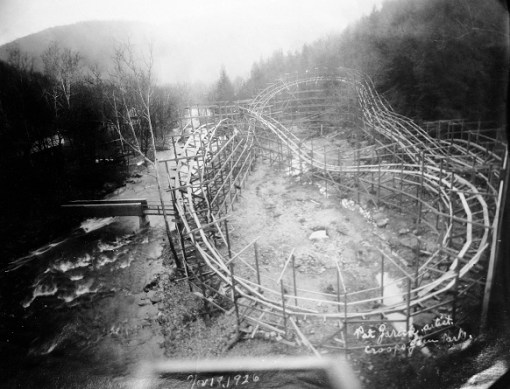
Between 1926 and 1927, two wooden roller coasters were added.

There was a full size coaster named Twister, and one Kiddie Coaster.

Both pictures  of “Twister” courtesy of the Philadelphia Toboggan Company

Roller Coaster Entrance

Photo Courtesy of Ellen Geisel

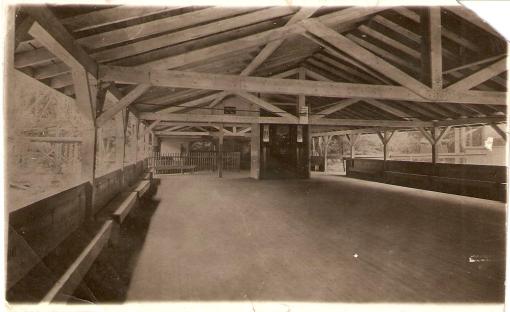
During an outing planned by the Nanticoke Unemployed League in June of 1935, as mothers were assembling on the pavilion with their children for a baby show along with observers, the floor of the pavilion, which was situated between 20 & 30 feet above the bed of Hunlock’s Creek, parted in the middle and then dropped.  A witness account described a “roar of furniture, crockery, glass and human bodies falling into the creek”.   

Croop's BAbandoned Park Picnic Tables in 2010

According to the newspaper ““The floor of the Pavilion broke in two, creating a large funnel into which tumbled men, women and screaming children, together with benches, chairs and tables and the paraphernalia   usually taken along by picnickers”.   Witnesses estimated that between 250 and 300 people were standing on the pavilion at the time of the accident. 

Dance Pavilion?  Could be…..

Photo Courtesy of Ellen Geisel

Fortunately, the sides and roof of the structure stayed intact, contributing to the fact that no one died during or after the catastrophe.   As a result of the collapse, 145 people were admitted to the hospital.  A local newspaper reported that “after the rescue work, shoes, purses, hats and bits of clothing could be seen in the wreckage, mute testimony of the horror that overtook the hundreds who were on the pavilion.”

The park was owned by B.F. Croop and the land was leased to Charles Shelly who was the park manager.  According to the newspaper, officials of the Nanticoke Unemployed League Council initially expressed belief that over-crowding caused the accident.  Complete details about the accident are available thru the Luzerne County Library System’s Sunday Independent online archives at “200 Picnickers Injured Here As Dance Pavilion Collapses”.

On July 10th, 1938, the newspaper reported that the park was being sued by 12 people for injuries sustained during the pavilion accident.  The majority were seeking $5,000 in damages, a few asked for $10,000 and the highest amounted to $15,000.  Visit “$96,000 Damages Asked by 12 for Injuries In Pavilion Crash” to see a list of the plaintiffs. 

While many people speculate that the accident and subsequent lawsuit led to the closing and abandonment of Croop’s Glen Amusement Park that does not seem to be the case.  An article from August of 1943 states:

 “Noted for years as one of the regions natural parks, Croop’s Glen this year is a complete casualty of the war effort.”

Carousel – photo by Croop’s Glen Art Studio

Photo Courtesy of Ellen Geisel

”The park has been renovated substantially since the dance hall collapse ten years ago, but the rollercoaster, whip, dodgem, merry-go-round and kiddies train, to mention the leading amusements have not turned a wheel this summer.”

Carousel

Photo Courtesy of Ellen Geisel

“They, as well as the penny arcade, refreshment and prize stands, are covered as protection from the elements.  The swimming pool, which for many years was one of the best patronized in the region, because of its mountain-fresh, ever-flowing water, has also gone to pot.”

Croop's D

Swimming Pool Remains in 2010

“It was a favorite place for basket outings and still has excellent facilities, including a large outdoor oven and scores of tables and benches if people were so inclined.”

Croop's c

Concession Stand/Picnic Grove in 2010

The article also mentions that lack of public transportation was contributing to the decline of the park.  You can access the full text of the article at “Park At Croop’s Glen Complete War Casualty” 

I was unable to find anything stating when the park officially closed, by some accounts; it remained open as a picnic spot through the mid-50s, with the dance hall serving as a skating rink. 

Croop's AAbandoned Park Picnic Grove Structure in 2010

More Croop’s Glen Updates Here

~*~*~*~*~*~*~*~*~*~*~*~*~

Return To

GUERRILLA HISTORY Table of Contents

facebook

Abandoned Pennsylvania--Lost History Found:  Croop’s Glen Amusement Park, Hunlock Creek   Cheri Sundra © 2012 All Rights Reserved


The Ghost of Gangster’s Paradise


Al Capone’s cell at Eastern State Penitentiary, Philadelphia.

ESP:  Gangsta Paradise

Everyone knows that legendary gangster Al Capone’s reign ended when he was found guilty of tax evasion, but did you know that doing time for a minor charge helped the notorious prohibition-era crime boss lay low after he ordered the most spectacular gangland slaying in mob history?

In 1929, on February 14th, seven members of Chicago’s North Side Irish gang were lined up in a warehouse/garage by two men from Capone’s South Side Italian gang dressed as police officers.  Thinking that it was a routine police raid, everyone peacefully did as they were told as the rival gunmen removed their weapons and then proceeded to pump their bodies full of lead using two Tommy guns, a sawed-off shotgun, and a .45.  Each of the seven victims received at least 15 bullets, mostly in the head.  The event became known as The Saint Valentine’s Day Massacre.

Shortly after The Massacre, during what is said to be a planned arrest, Capone is picked up in Philadelphia for carrying a concealed weapon, and sentenced to a year in Eastern State Penitentiary (ESP) where he could reside in safety behind bars in the “Park Avenue Block” of the prison. The warden and guards at ESP gave special consideration to Mr. Capone during his stay.   He was permitted to hang artwork in his private cell, was allowed to have tables, lamps, a velvet duvet, comfortable chair and even an expensive radio so he could listen to waltzes after dinner.  Capone was allowed to continue to conduct business.  The organized crime boss was able to use the warden’s office to make long-distance phone calls and to meet with his lawyer.  Capone was released from ESP two months early for good behavior!

While Capone’s time at ESP many have been relatively pleasant, he may not have left unaffected by his stay.  During the early years of the Twentieth Century, rumors about ghosts began to circulate at the prison.  While he was incarcerated at ESP, Capone began to be “haunted” by the “ghost” of James Clark, one of the St. Valentine’s Day Massacre victims and the brother-in-law of his rival Bugs Moran.  Other inmates reported that they could hear Capone yelling in his cell begging “Jimmy” to leave him alone.  The crime boss even contacted a psychic to get rid of the angry specter.  Years later, Capone would say that Clark’s vengeful spirit followed him from Eastern State Penitentiary and would follow him to the grave.  Fact, fiction, imagination or was Capone starting to show signs of the full-blown psychosis that would eventually start to haunt him when he was later incarcerated in Alcatraz for tax evasion?

Can’t get enough ESP?

Don’t miss the rest of the ESP Halloween Tales:

1. Haunted ESP (ghost on film)

2. The Eye of God and The Mad Chair

And

3. The Ghost Cats

@@@@@@@

Return To

GUERRILLA HISTORY Table of Contents

facebook


Cheri Sundra © 2012
All Rights Reserved

Haunted ESP (ghost on film)

The Pen

Eastern State Penitentiary (ESP) was designed to be a scary place.  Located in Philadelphia, this abandoned prison turned uber-cool museum has been kept in a state of “preserved ruin”, meaning no significant attempts have been made at renovation or restoration. The empty and ever looming guard towers, rusting doors, crumbling cell blocks and vaulted, water-stained ceilings make this veritable fortress an intimidating place for visitors.  It would be easy to assume that the spooky atmosphere could easily be playing ghostly tricks on the imagination, but those who have experienced strange events at ESP say that it is one of the most haunted places on the planet.

ESP Death Row

Cellblock 15: Death Row

Rumors about ghosts started to echo through the prison long before the penitentiary was closed down.  Almost anyone who spent time at ESP was certain that something supernatural was occurring behind those foreboding walls.  Guards often spoke of the sounds of unexplained footsteps in the corridors, pacing feet in cells, eerie wails emanating from the dark corners of the complex and dark shadows that resembled people flitting past darkened doorways.

Because of its long history, gloomy atmosphere and ominous appearance, ESP has been often used as a location for TV shows and films about the paranormal. Paramount Pictures used parts of the old prison for the filming of TRANSFORMERS: REVENGE OF THE FALLEN.   In the Brad Pitt/ Bruce Willis film TWELVE MONKEYS, it was the setting for a mental hospital.  ESP is a favorite spot for photographers, music videos and has inspired several video games.

ESP1

GHOST HUNTER’S catch a “ghost” on film at Eastern State Penitentiary  on a walkway just like the one pictured above….WORTH WATCHNG!  Less than one minute long.

GHOST HUNTER’S “GHOST” VIDEO

Eastern State Penitentiary is located on Fairmount Avenue in Philadelphia, just a few blocks away from The Philadelphia Museum of Art and The Franklin Institute.

facebook

@@@@@@@

Return To

GUERRILLA HISTORY

Table of Contents

Cheri Sundra © 2012
All Rights Reserved

The Ghost Cats

Eastern State Penitentiary2027 Fairmount Avenue, Philadelphia

Once the most famous and expensive prison in the world, Eastern State Penitentiary exists today in a conflicting condition known as  “preservation ruin”.  The result is a haunting world of empty guard towers and crumbling cell-blocks serving as a functional museum thanks to preservation efforts started by the Eastern State Task Force in 1988, the same year the building first opened for limited group tours.

ESP1

Representing a testimony to survival, The Ghost Cats was an artist installation at ESP created by Linda Brenner.  A colony of cats decided to take up residence at the abandoned jail after it closed in 1971.  For 28 years, “Dan the Cat Man” (Dan McCloud) devoted his time to visiting the abandoned prison to care for the cats.

ESP: Ghost Cat

Can You Find The GHOST CAT?

In 1993, The Spayed Club neutered the ESP cats and their population finally started to dwindle.  The last of the cats died off between 2002 and 2003.

Ghost Cat

Observant visitors could locate all 36 cat sculptures throughout the prison museum in Philadelphia, Pennsylvania.  The installation was placed beyond the areas where on-lookers are allowed access, in the hopes that the sculptures will be viewed as a part of the larger past existence of the life and history of the building.  The exhibit was dedicated to “Dan the Cat Man” who passed away in April of 2002.

Guard Tower ghost catGuard Tower GHOST CAT

Ghost Cat AlleyGHOST CAT Alley


ESP Death RowDeath Row

facebook

@@@@

Return To

GUERRILLA HISTORY Table of Contents